
On this page16 sections
In 2024, Shorts monetization accounted for 15% of YouTube's total ad revenue distribution. In 2025, that share reached 22%, a 7-point increase in one year, according to industry summaries of YouTube Shorts statistics. Yet many creators still earn only a small amount from large view counts because Shorts revenue doesn't work like long-form video revenue.
The reason is structural. YouTube places ads between Shorts into a shared pool, accounts for music-related costs, then distributes the remaining revenue according to each monetized creator's share of eligible views. The creator share is 45% of the allocated Shorts revenue, while YouTube retains 55%, as explained in YouTube's official Shorts monetization policy.
That percentage sounds simple. The payout experience isn't. Country mix, music usage, eligible views, and the size of the overall Shorts pool can change what similar view counts produce. This guide breaks down the mechanics, the practical numbers, and the point many beginners miss: Shorts may be more valuable as a discovery funnel than as a direct paycheck.
What YouTube Shorts Monetization Actually Means
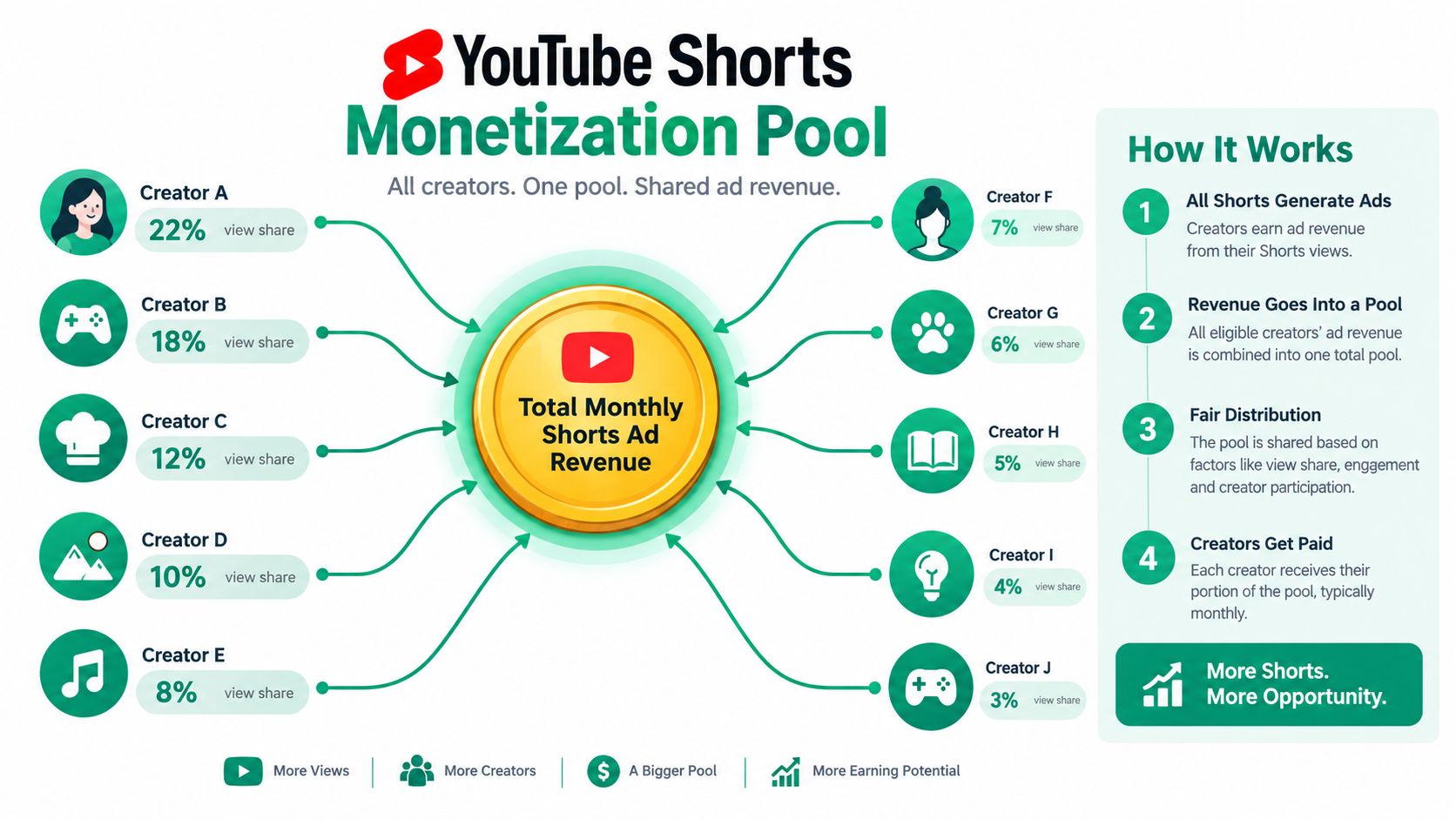
YouTube Shorts monetization is a pooled advertising system. YouTube sells ads that appear between Shorts, aggregates the resulting revenue, accounts for relevant music costs, and then distributes the allocated creator revenue according to each monetized creator's share of eligible views.
That differs from the familiar long-form model. With a regular video, ads are associated more directly with that creator's content, and earnings reflect factors such as the ad inventory shown around the video, audience geography, and watch behavior. Shorts viewers move through a shared feed, so the ad shown between two videos isn't treated as an ad sale belonging exclusively to the Short immediately before it.
The pool changes how you should read views
Suppose a creator generates 1% of all eligible Shorts views in a month. In simplified terms, that creator receives roughly 1% of the allocated Shorts creator pool, not a payment based on the number of ads that appeared directly on their own uploads. The example is useful because it shows why raw views don't tell the whole story.
The relevant calculation is closer to:
- Your eligible view share: Your eligible views divided by total eligible Shorts views.
- The available pool: Shorts ad revenue after the applicable allocation and music-related deductions.
- Your creator share: Your portion of the pool, with the creator percentage applied afterward.
This also explains why Shorts RPM is generally much lower than long-form RPM. A large pool is distributed across the entire eligible Shorts ecosystem, and the number of competing views is enormous. Industry reporting places Shorts RPM in many cases around $0.01 to $0.07 per 1,000 views, with some research finding Shorts RPM at only 3% to 14% of long-form RPM in many niches.
Practical rule: Treat a Short's view count as a reach metric first. Treat its revenue as the result of your share of a moving global system.
For beginners, the implication is straightforward. A single viral Short can create attention, subscribers, and future customers, but its direct ad value depends on how much of the wider Shorts ecosystem your eligible views represent. The next question is how YouTube applies the widely quoted 45% creator share.
How the 45 Percent Revenue Share Is Calculated
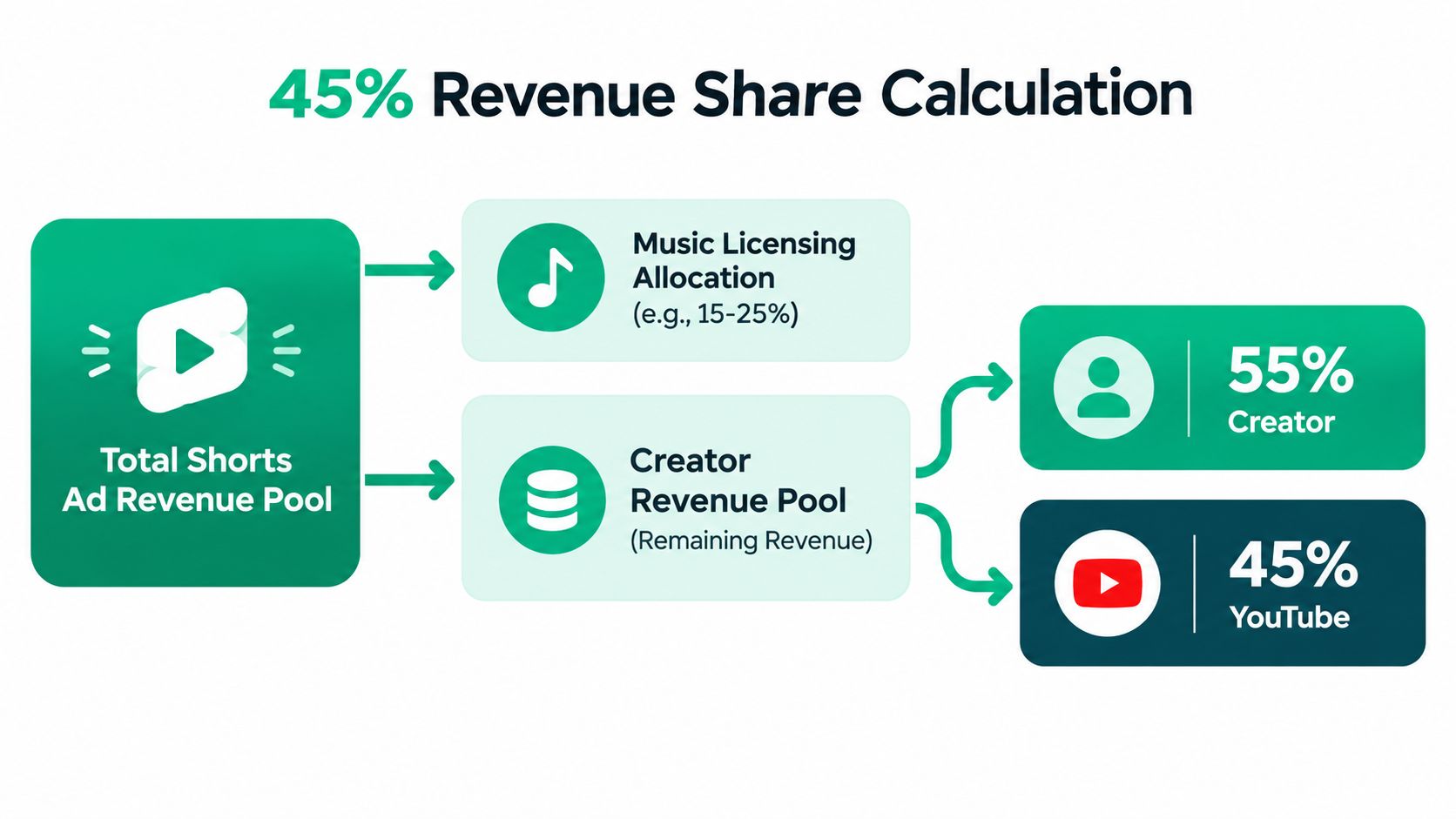
The 45% figure is not a commission on each ad impression attached to one Short. It is the creator's share after YouTube combines Shorts Feed ad revenue, accounts for music-related allocations, and distributes the remaining amount through its pool system. YouTube's official explanation of Shorts revenue sharing describes the process in four stages:
- YouTube gathers Shorts Feed ad revenue. Ads shown between Shorts contribute to a shared pool rather than being assigned directly to the upload beside them.
- Music-related allocations are accounted for. Licensed music can direct part of the revenue toward music costs before the creator distribution is calculated.
- YouTube determines each creator's eligible view share. The calculation uses eligible views within each country, so your share depends on how your views compare with other eligible Shorts views there.
- The allocated amount is split. Creators receive 45%, while YouTube retains 55% of the amount allocated for creator distribution.
Why the 45 percent isn't your RPM
RPM is the amount a creator effectively receives per 1,000 views. The 45% share is one stage of the calculation. RPM is the final result after the pool allocation, country-level audience mix, eligible views, music use, and total Shorts activity have affected the payout.
That difference prevents a common mistake. Seeing 45% does not mean a Short earns nearly half of the advertising value generated by its own views. The policy uses a proportional country-level creator pool, rather than a fixed CPM assigned to each upload.
A simple example shows the effect of music. Suppose your eligible views represent 1% of the allocated Shorts creator pool. If music-related costs have already reduced that pool, your 1% is calculated from the smaller amount, and you then receive the creator's 45% share of that allocation. An otherwise comparable Short with original audio may face a different deduction before the same percentage is applied, although eligibility and policy rules still matter.
The practical lesson is to calculate from the pool, not from the ad impressions appearing near one video. The 45% figure describes the final split, while your actual RPM reflects every step that comes before it.
Eligibility Requirements for Shorts Creators
Full YouTube Partner Program ad monetization through Shorts generally requires 1,000 subscribers plus one of two qualification routes: 10 million valid Shorts views in the prior 90 days or 4,000 valid public watch hours from long-form videos. Creators should verify the current thresholds on YouTube's official Partner Program requirements page, rather than treating a third-party summary as the program authority.
These routes are alternatives. Shorts viewing activity does not convert into long-form public watch hours, so the better route depends on how the channel attracts attention. A Shorts-first channel may pursue the view threshold, while a channel with a strong long-form audience may qualify through watch hours.
Apply through YouTube Studio
After reaching an available threshold, the workflow usually looks like this:
- Check the Earn tab: Open YouTube Studio and review the channel's monetization status.
- Accept the relevant terms: Shorts ad revenue requires agreement to the applicable module-based terms.
- Set up AdSense for YouTube: Payments require the associated account and verification process.
- Wait for review: YouTube reviews applications before monetization begins, and approval is not automatic.
A threshold is a gate, not a guarantee. YouTube can reject or delay an application if the channel fails Partner Program, copyright, or advertiser-friendly requirements. Reused material, unclear ownership, or policy violations can therefore matter even after the subscriber and view targets appear in Studio.
Shorts can also include videos of up to three minutes, but length does not change the qualification test. A longer Short still needs eligible views, original value, and policy compliance. It also remains part of the pooled Shorts system, where income depends on allocated revenue and audience geography rather than a fixed payment attached to each upload.
Creators should check regional availability and the latest Studio prompts because access conditions can vary by country and change over time. Shorts Feed ad revenue starts only after the channel joins the program and enables the relevant monetization terms. Until then, high view counts may build discovery and audience demand without producing a Shorts ad payout.
Comparing Shorts Ad Revenue With Other Income Streams
Shorts ads are only one part of a creator business. The strongest strategy often combines ad revenue with brand partnerships, fan funding, memberships, affiliate activity, products, or long-form content, because each stream monetizes a different type of audience action.
The contrast is especially clear when you compare the predictability of a direct sponsorship with a pooled Shorts payout. Shorts ads depend on eligible view share and the changing country-level pool. A brand deal, by contrast, is negotiated around the creator's audience, niche, deliverables, and commercial fit.
| Revenue Stream | Avg. Earnings per 1M Views | Payout Speed | Effort Level |
|---|---|---|---|
| Shorts Feed ads | Varies widely, often low relative to long-form | Platform payment cycle | Medium |
| Brand integration | Negotiated, not fixed by views | Contract-dependent | High |
| Super Thanks | Viewer-selected contribution | Platform payment cycle | Low to medium |
| Channel memberships | Recurring member payments | Platform payment cycle | Medium |
| Long-form funnel | Depends on long-form audience and ad economics | Platform payment cycle | High |
The table deliberately avoids pretending that every stream has a universal per-million-view rate. A sponsorship doesn't have a standard RPM, and a membership isn't purchased automatically because someone watched a Short. Those streams depend on trust, offer design, audience intent, and the creator's ability to move viewers beyond passive scrolling.
Use the right stream for the right audience action
A cooking creator might use Shorts to demonstrate one technique, then direct interested viewers to a longer recipe video, product recommendation, or paid cooking resource. A software educator might use a short tip to attract viewers who later watch a detailed tutorial or inquire about a service.
Super Thanks and memberships can add value when viewers feel connected to the creator, but they shouldn't be treated as guaranteed outcomes from reach alone. The same applies to brand deals. A large audience can help, but brands also care about relevance, credibility, and whether the creator can explain a product naturally.
The discontinued Shorts Fund belongs in historical context, not in a current revenue plan. YouTube's 2022 shift to ad revenue sharing established Shorts as a formal advertising stream, replacing the idea that creators should depend on a limited bonus fund. Engadget's coverage of the 2022 policy change describes the launch of the 45% creator share and the pool-based approach.
Shorts ad revenue pays for distribution. Your broader business should capture the value created by that distribution.
When Shorts Should Be a Funnel Instead of a Paycheck
For many creators, Shorts make more sense as the top of a funnel than as the main income engine. The format can deliver rapid discovery, but the advertising system rewards a share of a broad pool rather than the deeper viewing session that often supports more monetization opportunities in long-form content.
That doesn't make Shorts financially unimportant. It changes the question. Instead of asking only, “How much did this Short earn?” ask whether it brought the right viewers into a channel, newsletter, product, service, membership, or longer video.
Build a deliberate viewer path
A practical funnel might look like this:
- Shorts attract attention: Lead with a sharp problem, result, or surprising explanation.
- The profile creates context: Make the channel's topic obvious so a new viewer knows what to watch next.
- Long-form develops intent: Offer a detailed tutorial, review, interview, or analysis.
- The business captures value: Use appropriate memberships, products, services, sponsorships, or fan funding.
The format works best when the Short and the next destination answer the same viewer need. A random viral clip may generate views but fail to create useful demand. A focused Short about a spreadsheet formula can lead naturally to a full tutorial, while a broad meme may produce little interest in a specialized paid offer.
This approach is particularly relevant in markets where Shorts RPM is low. Independent reporting on Shorts monetization highlights the gap between YouTube's official revenue-share explanation and the practical questions creators ask about payout drivers, including music deductions, regional variation, and pool dilution.
A useful Short should therefore have a next action that feels relevant rather than forced. Invite viewers to watch the complete explanation, compare options in a longer video, download a resource, or follow a series. The goal isn't to make every viewer convert. The goal is to give high-intent viewers a clear path.
Practical Tips to Optimize Shorts Revenue
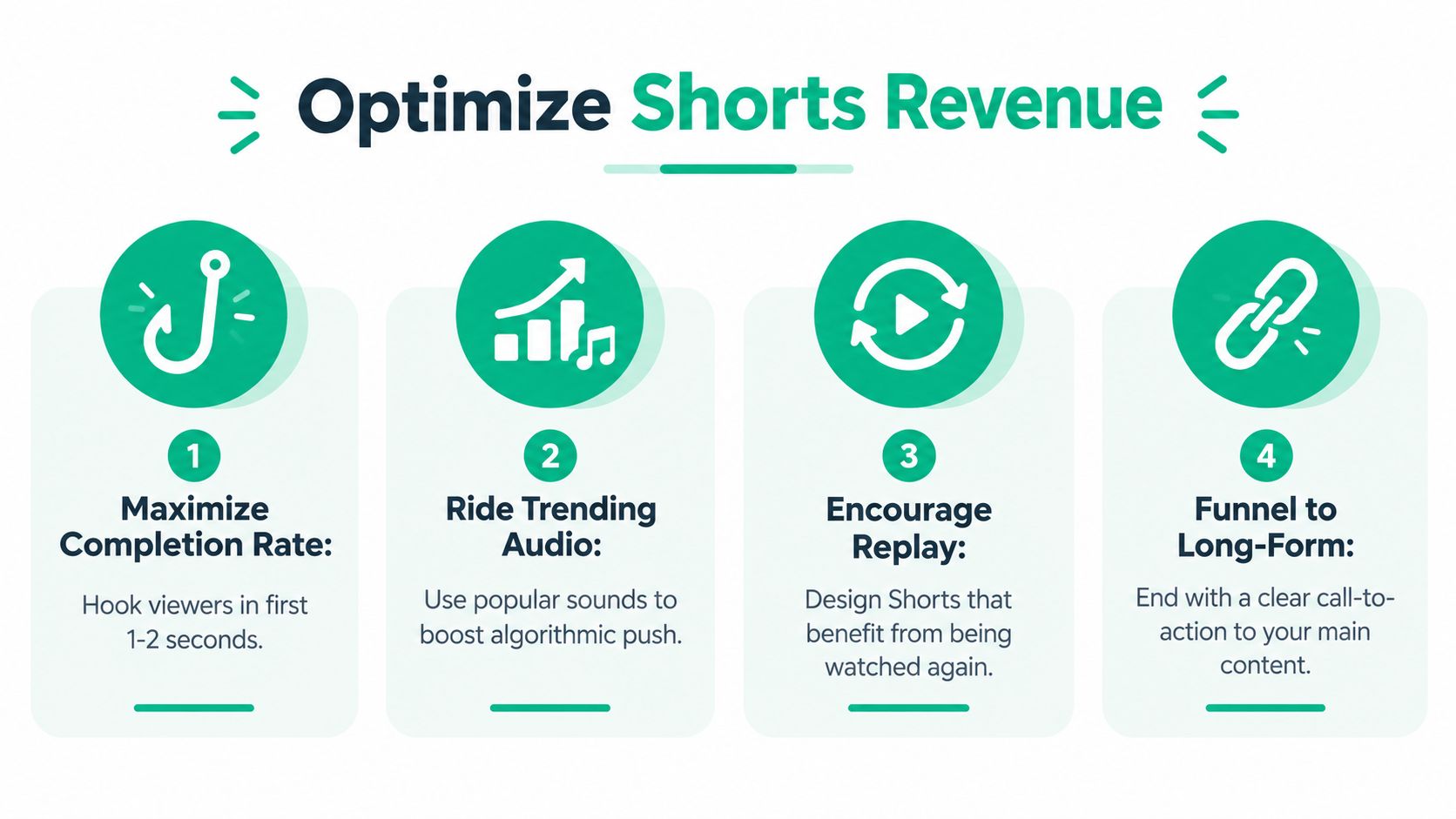
Optimization starts with the factors that determine whether a viewer continues watching and whether the view remains eligible for monetization. You can't control the size of the entire Shorts pool, but you can control the clarity of the opening, the originality of the content, the audience you attract, and the destination you offer next.
Improve the first viewing decision
The opening frame has to communicate a reason to stay. Begin with the result, the mistake, the question, or the visual change, rather than a long greeting or channel introduction.
- Lead with a specific promise: “This setting fixes the audio problem” is clearer than a general introduction.
- Show the subject immediately: Put the person, product, screen, or outcome on screen before the viewer has to infer the topic.
- Use captions as support: Keep text readable and place it where interface controls won't cover it.
- Design for completion: Remove pauses, repeated setup, and filler that weaken the sequence.
Retention doesn't create a fixed guaranteed payout, but it can help a Short generate more eligible viewing activity and stronger distribution signals. The practical target is not empty speed. It's a clear, satisfying progression from hook to payoff.
Treat music as a business decision
Trending audio can help a Short fit the culture of the feed, but licensed music can affect the revenue available for creator distribution. Original audio, spoken explanation, or music you have the right to use gives you more control over that part of the calculation.
That doesn't mean every creator should remove music. Use it when it improves the idea, then compare the result with voice-led or original-audio formats. A finance explainer, software walkthrough, or educational clip may not need a soundtrack at all.
Protect originality and production quality
Recycled clips, visible platform watermarks, minimal commentary, and copied scripts can create both audience and monetization problems. Make the transformation obvious through your own explanation, editing, examples, or analysis.
A research workflow can help. TransClipper analyzes YouTube Shorts and other short-form videos by generating transcripts and identifying elements such as hooks, structure, and calls to action, which can help creators study patterns without relying on repeated manual rewatching. Use that kind of analysis to understand structure, not to reproduce another creator's content.
Publish sustainably
A sustainable schedule is more useful than a volume target you can't maintain. Batch ideas, record related clips together, review which openings hold attention, and keep a simple log of topic, hook, audience, and next action.
Measure more than views:
- Eligible revenue: Check whether views contribute to monetization.
- Audience geography: Identify where viewers come from.
- Subscriber quality: See whether new subscribers watch related content.
- Funnel behavior: Track movement into long-form videos or other offers.
- Content originality: Remove anything that depends on borrowed footage without meaningful creative value.
The best optimization isn't the one that produces the most views. It's the one that produces the most useful viewers without weakening monetization eligibility.
Country-Level Shorts RPM Comparison for 2026
Geography can matter more than raw view count because advertisers buy access to audiences in particular markets. YouTube's Shorts allocation is calculated by country, so a creator with a high share of viewers in a stronger advertising market can experience a different effective RPM from a creator with the same number of views in a lower-RPM market.
The country-level figures below come from independent 2026 Shorts RPM data. They are useful comparison points, not guarantees for an individual channel.
| Region or Country | Estimated Shorts RPM in USD | Notes |
|---|---|---|
| United States | $0.328 | Highest figure listed in the source |
| United Kingdom | $0.166 | Strong advertising market |
| Germany | $0.163 | Strong advertising market |
| Brazil | $0.045 | Lower than the leading markets listed |
| Mexico | $0.040 | Lower-RPM market in the comparison |
| India | $0.008 | Very low figure in the comparison |
| Indonesia | $0.012 | Very low figure in the comparison |
These figures change the way creators should evaluate a Shorts-first strategy. A channel aimed primarily at viewers in India or Indonesia may need a very different business model from a channel reaching a substantial U.S. audience. That doesn't mean lower-RPM markets lack opportunity. It means creators may gain more by using Shorts to sell expertise, build long-form demand, attract memberships, generate Super Thanks, or support brand and service revenue.
The broader market range is also wide. Independent summaries report Shorts RPM commonly around $0.01 to $0.07 per 1,000 views in many cases, while the country comparison above shows that some channels can sit outside that general range depending on audience composition and methodology.
Use your own Analytics data rather than relying on a global average. Export revenue and eligible-view information, group results by audience geography, and calculate a personal average RPM over a meaningful period. Then estimate what your existing audience mix can support before changing language, topic, or format purely to chase a higher-paying market.
A bigger global Shorts revenue share doesn't automatically mean bigger creator income in every country.
The most durable plan combines audience fit with monetization fit. Create Shorts that attract the people you can serve, then decide whether direct ads, long-form content, products, memberships, or partnerships should carry the larger share of the business.
If you're building a Shorts research and production workflow, use TransClipper to turn YouTube Shorts into searchable transcripts and inspect hooks, structure, and calls to action before developing your own original content. Visit the platform to organize short-form analysis and identify repeatable patterns that support a more deliberate monetization strategy.


