
On this page22 sections
TikTok creators earned $4.1 billion in 2024, and the projection for 2025 is $5.7 billion, which makes the platform less like a hobby feed and more like a serious creator economy engine Teleprompter's TikTok statistics roundup. That money doesn't flow to random uploads. It flows to creators who build repeatable formats, study retention, and treat every post like a test.
That's the shift this guide is built around. Instead of guessing what might work, you can use tiktok content creation tips as a system for planning, filming, analyzing, and improving. The strongest accounts aren't just creative, they're methodical. They reuse winning hooks, tighten their pacing, and keep a loop between production and performance review.
A practical starting point is to think in batches, not single posts, and to favor strategic consistency over chaotic volume. Independent guidance suggests a cadence of 1 to 4 times per week, with the note that a few strong videos can outperform daily posting when the concept is relevant and well executed Teleprompter's TikTok statistics roundup. That's the right mindset for 2026, less scramble, more process. If you want a framework for that process, this data driven tips for creators approach is exactly where to start.
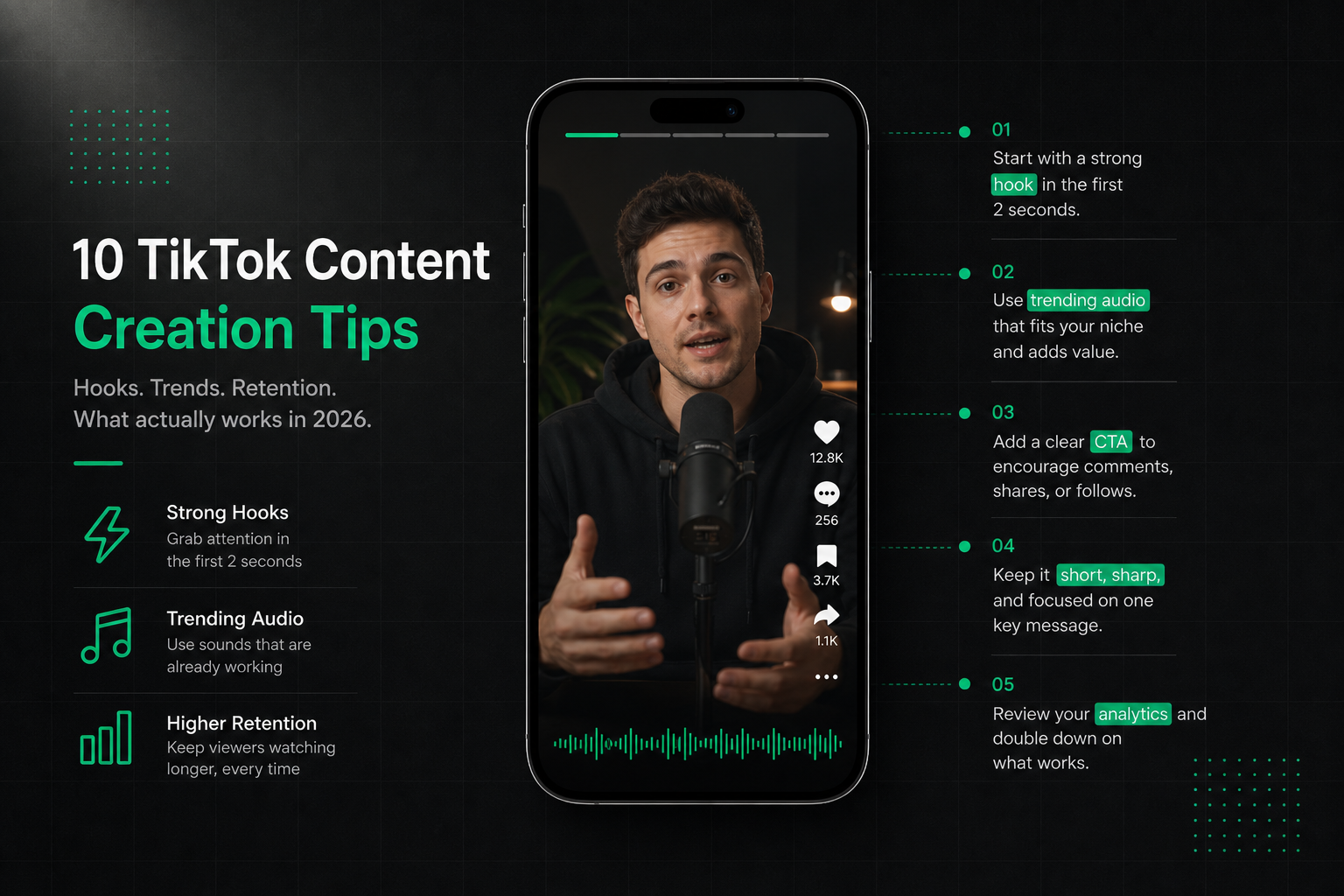
1. Master the Hook First 3 Seconds
The first job in TikTok content is not filming, editing, or posting. It is earning attention before the thumb moves on. A 2026 strategy guide recommends treating the opening 0 to 3 seconds as the main optimization window, with a strict Hook → Context → Payoff → CTA sequence SEO Sherpa's TikTok content strategy guide.
A hook can be a question, a contrarian statement, a visual interruption, or a line that creates tension right away. The common mistake is opening with setup instead of energy. If the viewer has to wait for the point, they usually will not stay.

What strong hooks actually look like
Practical rule: If the opening line would still make sense in a podcast intro, it is probably too slow for TikTok.
A better hook sounds like an immediate payoff or a sharp promise. “Wait for the ending” works when the visual supports it. “This product saved me from doing X manually” works because it names the benefit fast. Reaction hooks also perform well because they create a built-in reason to keep watching, especially when the facial expression or cut happens instantly.
Use tools that help you test hook angles instead of inventing one line and hoping for the best. The TransClipper Viral Hook Generator is useful for brainstorming alternatives, but the value comes from comparing several openings against the same core idea. Study competitor intros, transcribe them, and look for recurring patterns in structure, wording, and visual pacing.
If you work in a niche like beauty, finance, or fitness, match the hook to the audience's actual pain point. Broad curiosity hooks can get views, but a specific pain-point hook often gets the right viewers. That matters more over time because the algorithm distributes content in a crowded feed, and relevance wins when attention is scarce.
A hook also works better when the caption reinforces the same promise. For tighter scripting, use a developer-focused guide to TikTok captions that go viral to align the first line, on-screen text, and spoken setup so the viewer gets one clear reason to keep watching.
2. Leverage Trending Sounds and Audio
Audio is not background decoration on TikTok. It's part of the discovery system. One reason trend adoption matters is that the platform organizes and recommends content around sounds, so the right audio can help the right video travel further.
Timing matters too. Trend participation only helps if you act fast enough to stay inside the window where people still recognize the sound, but not so generic that your post becomes indistinguishable from the pack. That's why creators who use trending audio early, then pair it with a niche-specific visual angle, usually get more durable mileage than accounts that copy the trend exactly.
The mistake is treating trending sounds as a shortcut. They're not. They're a distribution layer. The content still has to do the actual work.

Use trends without losing your voice
The best use of a trend is selective, not compulsive. A seasonal sound, a branded sound, or a challenge clip can all work if they fit your message, but they should still sound like your account. A real estate creator can use a trending audio clip to frame a first-time buyer misconception. A skincare brand can use the same approach to dramatize a routine mistake.
Trendy does not have to mean generic. That's the core trade-off. When you force a trend into the wrong niche, the video can feel borrowed and disposable. When you adapt the trend to a clear point of view, it feels current without becoming copycat content.
A useful workflow is to keep a running list of sounds that already fit your audience, then check competitor posts for how they've been used. If you're making developer-focused content, a tighter caption strategy can help you connect the sound to the message more clearly, and this developer-focused TikTok caption tips resource is a helpful companion when you're pairing audio with text.
The win is speed plus fit. Don't chase every trend. Pick the ones that reinforce the identity you already want your account to own.
4. Optimize Posting Frequency and Timing
Posting frequency matters, but only when it supports a repeatable workflow. More uploads help if you can keep quality steady and learn from what each post does. A practical cadence is to publish often enough to stay visible, but not so often that every clip feels rushed or interchangeable. The goal is a rhythm your team can maintain, because consistency beats bursts of activity followed by long gaps.
That matters for another reason too. A predictable schedule makes batching easier, and batching removes a lot of the friction that causes creators to stall. It also gives you a cleaner testing environment, since you are changing one variable at a time instead of guessing whether a sudden spike came from timing, topic, or hook quality.
The bigger lever is audience behavior. Generic “best time to post” charts can give you a starting point, but TikTok Analytics is more useful because it shows when your own viewers are active. A student-heavy audience may cluster at different hours than parents, shift workers, or business buyers, so the right posting window depends on who follows you.
Build a schedule you can repeat
Batching works best when it is tied to testing, not just efficiency. Film a group of clips in one session, then vary the hook, caption, sound, and visual opening so you can compare performance across similar ideas without rebuilding the whole production process each time. That makes it easier to see whether one topic is strong enough to support multiple posts or whether the format needs work.
Timing should also reflect the kind of content you publish. A quick tip video can do well when your audience is casually scrolling, while a heavier tutorial may perform better when viewers have more time to watch and finish. Some creators also see stronger results when they publish close to the moments their audience usually checks the app, which is why a simple schedule based on their own analytics often beats guessing from broad advice.
Use your analytics as a feedback loop. Watch for patterns in watch time, completion rate, and early engagement, then adjust the posting window and repeat the test. If one slot consistently underperforms, move it. If one time reliably pulls stronger starts, keep it and build around it.
The SEO Sherpa's TikTok content strategy guide is useful here because it reinforces the broader point, timing matters most when it is matched to your audience and your script structure. The TransClipper TikTok script generator can also help you keep the process moving by turning one idea into multiple testable variations without starting from zero every time.
One useful rule: if your schedule cannot survive a busy week, it is too complicated. A posting system only works when it is easy to repeat, easy to measure, and easy to adjust based on what the numbers show.
5. Study and Analyze Competitor Content Systematically
Competitive analysis is one of the fastest ways to stop making content in the dark. You don't need to copy other creators. You need to identify the mechanics behind what holds attention in your niche, then use those mechanics in your own voice.
Start with a small set of accounts already earning the kind of attention you want. Review their hooks, lengths, visuals, CTAs, and pacing, then compare top performers over time instead of fixating on one viral post. A single breakout video can mislead you, while repeated patterns show what drives response.
A beauty creator might notice that a certain opening phrase keeps showing up before tutorial videos. A finance creator might find that direct problem statements outperform broad educational intros. A brand account may realize that product demos with visible movement beat static talking-head clips.
Turn observation into a repeatable habit
Don't just watch. Log what you see. Note the content format, the first line, the video structure, the sound choice, and where the CTA appears. That gives you a pattern library instead of a vague impression that “their videos are good.”
Watch five videos, and you'll get opinions. Watch fifty, and you'll start seeing system-level patterns.
That's the point. The strongest creators use competitor analysis to reduce guesswork, not to imitate surface style. Teleprompter's TikTok statistics roundup supports the broader reality that TikTok performance tends to reward repeatable behavior, not random bursts of effort. If two accounts in your niche use similar hooks but only one keeps viewers longer, the difference is usually in pacing, payoff, or how clearly the video solves a problem.
Use that insight to build a testing loop. Borrow one element at a time, then compare results across several posts before deciding whether it belongs in your own system. If a hook format keeps working, keep it in rotation. If a visual pattern boosts retention, fold it into future shoots. The goal is not imitation, it is a controlled process that helps you identify what deserves to be repeated.
5. Study and Analyze Competitor Content Systematically
Competitive analysis is one of the fastest ways to stop making content in the dark. You don't need to copy other creators. You need to identify the mechanics behind what holds attention in your niche, then use those mechanics in your own voice.
The most useful analysis starts with a small set of accounts that are already getting the kind of attention you want. Look at their hooks, lengths, visuals, CTAs, and pacing. Then compare their top videos across time instead of obsessing over a single viral hit. Patterns matter more than outliers.
A beauty creator might notice that a certain opening phrase keeps recurring before tutorial videos. A finance creator might see that direct problem statements outperform general educational intros. A brand account may realize that product demos with obvious movement beat static talking-head clips.
Turn observation into a repeatable habit
Don't just watch. Log what you see. Note the content format, the first line, the video structure, the sound choice, and where the CTA appears. That gives you a pattern library instead of a vague impression that “their videos are good.”
Watch five videos, and you'll get opinions. Watch fifty, and you'll start seeing system-level patterns.
That's the point. The best creators use competitor analysis to reduce guesswork, not to imitate surface style. If two accounts in your niche use similar hooks but only one keeps viewers longer, the difference is usually in pacing, clarity, or payoff, not in a flashy editing trick.
This also helps you avoid stale strategy. A format that worked last month may already be fading, especially in fast-moving niches. By reviewing competitors regularly, you'll notice when a visual style or narrative pattern starts losing force and when a new format begins to emerge.
6. Create Clear and Compelling Calls-to-Action
A CTA should tell the viewer exactly what to do next. Too many creators waste the ending with something vague like “thoughts?” or “let me know.” That feels easy to write, but it rarely gives the viewer a specific next step.
The stronger approach is to match the CTA to the goal. If you want comments, ask a focused question. If you want followers, tell people what kind of content they'll get. If you want shares, explain who the video is for. The CTA should feel like the natural final step, not a sales interruption.
Placement matters too. A CTA that appears too early can pull attention away from the point of the video. A CTA that comes after the payoff can feel tacked on. The best version is built into the flow so the viewer barely notices the shift.
Make the action feel useful
Focus on user benefit, not just creator benefit. “Follow for more TikTok content creation tips every week” is clearer than “follow me.” “Comment your niche and I'll suggest a hook” gives people a reason to respond. “Share this with the teammate who runs your account” connects the post to a specific use case.
If you are building a conversion path, the CTA should match the video's promise. A product demo should push toward the next step, not stop at engagement. A tutorial should invite the viewer to save, share, or come back to it later.
The practical lesson is simple. One strong CTA beats three weak ones. When you stack multiple asks into the same video, you split the response and make the decision harder. Keep the instruction clear, conversational, and tied to the exact content in front of the viewer.
7. Leverage User Generated Content and Duets Stitches
Duets and stitches are some of the most underused growth tools on TikTok because they let you enter a conversation that already has momentum. You don't need to start from zero when the platform already has a relevant post circulating. You can respond, correct, extend, or react.
That matters because these formats fit the native behavior of the app. They also make your content feel more social and less broadcast-only. A stitch that adds useful context can outperform a standalone explanation because it rides on a topic people are already paying attention to.
The mistake is using the feature like a lazy repost. If all you do is echo the original clip, you add almost no value. The strongest duets and stitches show a clear point of view, a useful correction, or a reaction that makes the original content better.
Build content that invites response
Create posts people can answer. Ask a specific question, make a bold claim that can be challenged, or show part of a process that someone else would naturally want to react to. That gives other creators and viewers a reason to engage with your material directly.
A good stitched response can turn one post into a conversation thread. A brand can stitch a customer complaint and show the fix. An educator can stitch a misconception and replace it with a clearer explanation. A comedian can duet a dramatic clip and use timing to create contrast.
The community effect matters too. When people see that you respond to their content, they're more likely to engage with yours. That creates a feedback loop that feels social instead of promotional. It also helps smaller accounts borrow context from larger conversations without pretending to be bigger than they are.
8. Optimize Video Length for Platform and Content Type
There isn't one ideal TikTok length. The right length depends on what the video has to do. A comedy clip needs to land fast. A tutorial needs enough room to explain. A story needs enough time to create tension and resolve it.
That's why chasing a single “optimal length” is a trap. Completion rate matters more than the number of seconds on the timeline. A shorter video can be easier to finish, but a longer video can still perform if it stays tight and holds interest.
The practical move is to match the format to the message. If the content is simple, keep it short. If the content is layered, give it the time it needs, but trim every unnecessary second. That's especially important on TikTok, where people are deciding almost instantly whether the next frame is worth their attention.
Trim for clarity, not just speed
A lot of creators cut videos only to make them shorter, which is the wrong goal. Cut to remove repetition, dead air, and setup that doesn't add meaning. If a line, gesture, or cut doesn't change the viewer's understanding, it probably doesn't belong.
Different formats also behave differently. Educational content often needs enough space to explain the idea cleanly. Product demos need enough time to show the promise and the proof. Storytelling needs a pace that lets the arc breathe without dragging.
Use your own analytics to compare video length against watch behavior. If your audience finishes shorter clips more often but comments more on longer ones, that tells you something about what they value. The answer may not be “always shorter.” It may be “shorter for discovery, longer for depth.”
9. Build Niche Expertise and Consistent Aesthetic
TikTok rewards creators who feel recognizable. That doesn't mean every video has to look identical. It means viewers should be able to understand what you do, what you care about, and why they should trust your content after a few posts.
A clear niche helps because it reduces confusion. If your account jumps between unrelated topics, people struggle to know why they should follow. A consistent aesthetic helps too, because recurring visual cues make your content easier to spot in the feed.
Many creators overcomplicate branding. You don't need a cinematic identity package. You need enough consistency that your topic, tone, and style are easy to recognize. That can come from a repeated color palette, a regular filming setup, a signature pacing style, or the same kind of opening language.
Make the account feel intentional
Pick a few content pillars and stay close to them long enough for the audience to learn your lane. A creator focused on productivity can rotate between desk setup, workflow tips, and app reviews. A beauty account can lean into tutorials, product tests, and routine breakdowns. A finance account can build around simple explanations, mistakes to avoid, and decision frameworks.
Then lock in the look. If your videos use the same fonts, framing, or voice style, the account starts to feel cohesive. That doesn't just help viewers. It helps you batch because you're not reinventing the visual system every time you film.
The trade-off is real. Tight niche positioning can feel limiting at first. But broad, unfocused content usually takes longer to gain traction because the audience can't place you. Consistency gives the algorithm and the viewer a cleaner signal.
10. Iterate Based on Analytics and Performance Data
Guesswork ends here. Every video gives you data, and the creators who grow steadily are the ones who use it. The 2026 strategy guidance is clear, watch time, completion rate, shares, and saves matter more than vanity metrics because they tell you what the content did, not just how many people passed by it SEO Sherpa's TikTok content strategy guide.
Treat each post like an experiment. One week, test a sharper hook. Another week, test a different length. After that, compare how each version affected retention and response. If you change too many things at once, the results get muddy and you learn nothing useful.
A simple spreadsheet can be enough. Track the hook type, length, sound, topic, CTA, and the outcome. Over time, patterns become obvious. Certain openings may hold attention better. Certain topics may generate more saves. Certain formats may bring followers more reliably than others.
Use the data to remove weak habits
The point of analytics isn't to admire your best numbers. It's to make decisions. If one style keeps underperforming, stop forcing it. If one format keeps winning, build on it before the pattern fades.
The TransClipper Viral Video Analyzer fits naturally into this workflow because it helps you break down hooks, structure, and CTA patterns without manually rewatching everything. That's useful when you're comparing your own posts against competitors and trying to see why certain videos hold up better than others.
Practical rule: Change one variable at a time, then give the result enough room to mean something.
That discipline is what turns content into a feedback loop. You stop asking, “What should I post?” and start asking, “What did the last ten posts teach me?” That question is much more useful, because it turns every upload into a step in a broader system.
Top 10 TikTok Content Tips Comparison
Use this as a quick map — pick the tip that matches your bottleneck, then stack the next ones as you grow.
Master the Hook (First 3 Seconds)
- Complexity: Medium — ongoing creativity & A/B testing
- Resources: Low–Medium — quick edits, ideation time
- Outcomes: Higher completion rates and broader reach
- Best for: Short clips, attention-critical openings, cross-niche
- Why it works: Strong algorithmic boost; improves retention
Leverage Trending Sounds and Audio
- Complexity: Medium — trend monitoring & timing sensitivity
- Resources: Low — use the platform sound library; daily checks
- Outcomes: Significant organic discoverability uplift
- Best for: Dances, memes, early trend participation
- Why it works: Built-in audience familiarity; rapid reach growth
Perfect the Hook → Problem → Twist → Payoff Structure
- Complexity: High — scripting and pacing discipline
- Resources: Medium — planning, edits, possible reshoots
- Outcomes: Very high retention and shareability when executed
- Best for: Educational, storytelling, product demos
- Why it works: Repeatable framework that increases completion
Optimize Posting Frequency and Timing
- Complexity: Medium — scheduling + analytics monitoring
- Resources: Medium — content pipeline and batching
- Outcomes: Better initial engagement velocity and steady growth
- Best for: Growth-focused creators, niche-building accounts
- Why it works: Signals activity to the algorithm; builds audience habit
Study and Analyze Competitor Content Systematically
- Complexity: Medium–High — structured analysis required
- Resources: Medium — time and/or analytics tools
- Outcomes: Faster learning curve; data-driven strategy gains
- Best for: New creators, market research, strategy planning
- Why it works: Reveals proven patterns; reduces guesswork
Create Clear and Compelling Calls-to-Action (CTAs)
- Complexity: Low–Medium — placement and wording tests
- Resources: Low — simple text/voice edits; A/B runs
- Outcomes: Measurable increases in follows, comments, conversions
- Best for: Conversion-focused or engagement-driven posts
- Why it works: Directs audience behavior; improves conversion rates
Leverage User-Generated Content and Duets/Stitches
- Complexity: Low–Medium — quick turnaround and selection
- Resources: Low — builds on existing content, fast to produce
- Outcomes: High engagement and audience crossover potential
- Best for: Reactions, collaborations, community growth
- Why it works: Low-friction growth; algorithm favors interactive formats
Optimize Video Length for Platform and Content Type
- Complexity: Medium — requires testing and trimming
- Resources: Low–Medium — editing effort per length variant
- Outcomes: Improved completion rate when length matches content
- Best for: Education (longer), comedy/challenges (shorter)
- Why it works: Aligns format to attention patterns; boosts watch-time
Build Niche Expertise and Consistent Aesthetic
- Complexity: High — long-term discipline and focus
- Resources: Medium–High — branding, production consistency
- Outcomes: Strong loyalty, recognition, and monetization potential
- Best for: Brand builders, authority creators, partnerships
- Why it works: Predictable growth; easier batching and brand deals
Iterate Based on Analytics and Performance Data
- Complexity: Medium–High — measurement and controlled tests
- Resources: Medium — analytics tools and record-keeping
- Outcomes: Compounding optimization and scalable growth
- Best for: Scaling creators, teams, performance-driven strategies
- Why it works: Data-backed improvements; removes guesswork
Your Blueprint for Sustainable TikTok Growth
Becoming a successful TikTok creator isn't about mastering one trick. It's about building a system that keeps improving. When you combine strong hooks, clear structure, smart use of trends, and disciplined analysis, your content stops depending on luck and starts depending on process.
That process matters because TikTok is crowded, fast, and highly competitive. The platform's scale, the volume of daily uploads, and the amount of time people spend scrolling all point to the same conclusion, the first seconds and the clearest ideas win attention more reliably than vague creativity Printful's TikTok statistics summary. Your job is to make every video easier to understand, easier to finish, and easier to act on.
The best creators also know when not to chase noise. They don't copy every trend, post without a plan, or keep repeating formats that no longer work. They test, review, and refine. That's how a creator moves from random uploads to a repeatable engine.
Use these tiktok content creation tips as your operating system. Build in batches, keep your niche clear, and use your analytics to decide what deserves another round. The next breakthrough doesn't come from hoping the algorithm notices you. It comes from making the next post better than the last one.
If you're serious about shortening the guesswork, use tools that show you what's happening inside successful short-form videos. Boost engagement with Veo3 AI if you want another perspective on short-form growth, and keep your own workflow rooted in testing, not assumption.
If you want to turn TikTok research into a repeatable workflow, TransClipper helps you analyze hooks, structure, and calls to action from short-form videos in seconds. Use it to study what works, build better scripts, and keep a searchable library of ideas as you grow.


