
On this page33 sections
You posted a video that should have worked.
The idea was solid. The edit was clean. The information was useful. Maybe you even copied the format from a creator in your niche who gets consistent reach. Then the video goes live, and the graph falls off almost immediately. A few people watch. Most swipe.
That moment is where a lot of creators start blaming the algorithm, their niche, or their editing. But the problem usually shows up earlier than that. It happens before the content gets a fair chance. The viewer makes a snap decision in the opening moments, and your video either passes through that gate or gets rejected.
That's why the Hook Method matters. In short-form video, the first seconds aren't just an intro. They're an audition. A 2026 Frontiers in Communication article describes hooks as a central attention strategy in crowded digital media, and notes that in short video the hook can be the spoken content itself, not just the title or thumbnail. The same source cites a 2023 VidMob TikTok creative analysis of 1,678 ads and 7.3 billion impressions, reporting that effective hook-driven creative boosted engagement by 2x and increased purchase intent by 43% in the first six seconds of a TikTok ad (research summary).
If you're working on hooks for YouTube Shorts, TikToks, or Reels, that should reframe how you script. You're not writing an opening line because it sounds clever. You're building a gate that earns the next few seconds.
The practical shift is simple. Stop asking, “Is this a good hook?” Start asking, “Does this opening create enough attention, relevance, and promise to keep someone from swiping?”
That question changes everything. It changes how you write. It changes what you test. It changes how you read retention graphs. And it makes the rest of your video easier, because when the opening does its job, the body finally gets seen.
Introduction Why Your First Seconds Decide Everything
A short-form feed is a conveyor belt. Every video gets a split-second trial, and every viewer acts like a ruthless editor. They don't care how long you planned, how polished the b-roll looks, or how smart the takeaway becomes at the end. They care whether the beginning feels worth their attention right now.
That's the use of the hook method. It's not a bag of catchy lines. It's a way to earn attention before your audience has committed.
Why good videos still flop
Most weak openings fail in one of three ways:
- They start too wide: “Here are some tips about productivity” gives the viewer no reason to care yet.
- They delay the point: a logo animation, soft greeting, or scene-setting shot burns precious attention.
- They hide the payoff: the value exists, but the audience can't see it quickly enough.
The pain is that the rest of the video may be excellent. The audience just never reaches it.
A weak hook doesn't mean your idea is bad. It means the viewer couldn't detect the value fast enough.
Think of the opening as a gate
The strongest way to think about the hook method is this: the opening is a 3-second attention gate. If the video clears that gate, the viewer gives you more time. If it doesn't, the body, twist, and payoff never get a chance.
That framing is more useful than “make it catchy” because it turns a fuzzy creative problem into a measurable one. You can inspect the first frame. You can rewrite the first line. You can compare variants. You can watch retention and see whether people stayed.
The structure underneath many strong videos
A lot of effective short-form clips follow a simple engine:
- Hook
- Problem
- Twist
- Payoff
This doesn't mean every video must sound formulaic. It means the video gives the audience four things in sequence: a reason to stop, a reason to care, a reason to stay curious, and a reason to feel rewarded.
That sequence matters whether you're teaching, selling, storytelling, or reacting. It also gives analysts and creators a shared language. Instead of saying “this video feels strong,” you can say, “the hook was clear, but the problem arrived too late,” or “the twist promised novelty, but the payoff didn't resolve it.”
What the Hook Method Really Means in Short Form Video
The phrase hook method sounds simple, but people often flatten it into “say something interesting first.” That misses the mechanism.
A fishing hook doesn't feed the fish. It catches attention long enough to create connection. In short-form content, a hook does the same thing. It doesn't need to explain everything. It needs to create enough friction, relevance, or curiosity that the viewer gives the next moment a chance.
A hook is bigger than a line
In crowded feeds, the hook can appear in several places at once. A 2026 Frontiers in Communication discussion of hook strategy frames hooks as attention-capturing elements in digital media and notes that they classically show up as striking titles or thumbnails, while on short-video platforms they can also be the spoken content itself (discussion summary).
That means your hook might be:
- Visual: a strange first frame, quick motion, facial reaction, object reveal
- Verbal: a line that creates tension, contrast, or curiosity
- Textual: bold on-screen words that communicate the premise without sound
The strongest openings often combine more than one.
Four jobs a real hook should do
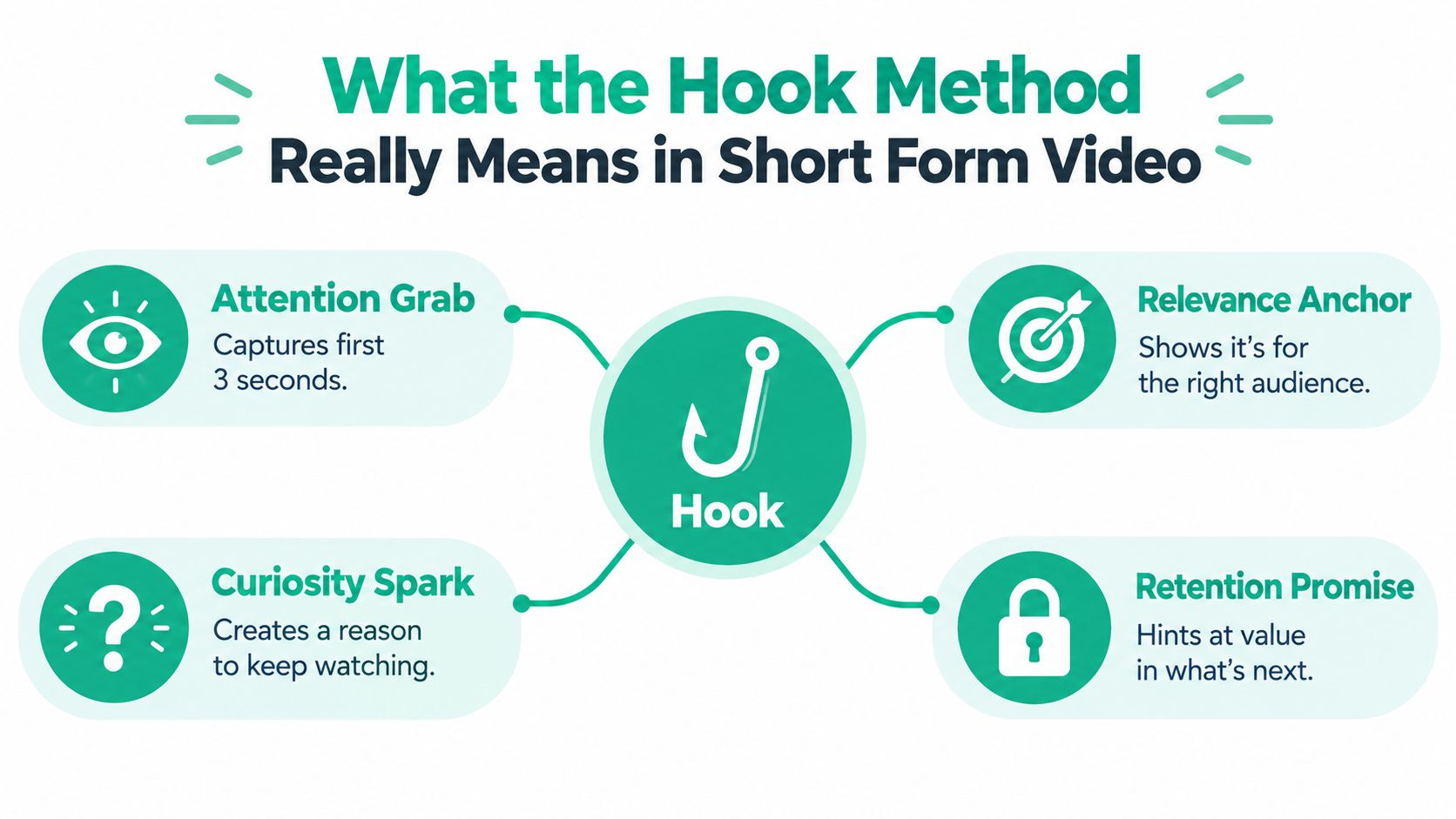
A methodical hook usually handles four jobs at once:
- Attention grab: it interrupts the autopilot scroll.
- Relevance anchor: it signals who this is for.
- Curiosity spark: it opens a gap the viewer wants closed.
- Retention promise: it hints that a useful or surprising payoff is coming.
A generic opener often does only one of those. “I want to talk about meal prep” may identify the topic, but it doesn't interrupt, sharpen relevance, or promise a payoff.
Why creators get confused here
People often confuse topic with hook.
If you say, “This is how I organize my camera bag,” that's a topic. It might work if the visual setup is strong, but by itself it doesn't necessarily stop anyone. If you say, “I stopped carrying three things every camera creator swears by,” now you've added tension and contrast.
The difference isn't hype. It's structure.
If you study faceless content, a useful reference point is this ClipNova faceless reels review, because faceless formats make the hook question more obvious. Without facial expression to do the stopping, creators have to rely harder on text, motion, pacing, and first-frame clarity.
For creators who want a clearer scripting lens, this guide to video script structure is helpful because a hook performs better when it's tied to what follows, not treated like a separate gimmick.
Practical rule: A hook isn't the first sentence. It's the first moment that makes the viewer think, “Wait, what's this?”
How the Hook Problem Twist Payoff Structure Works
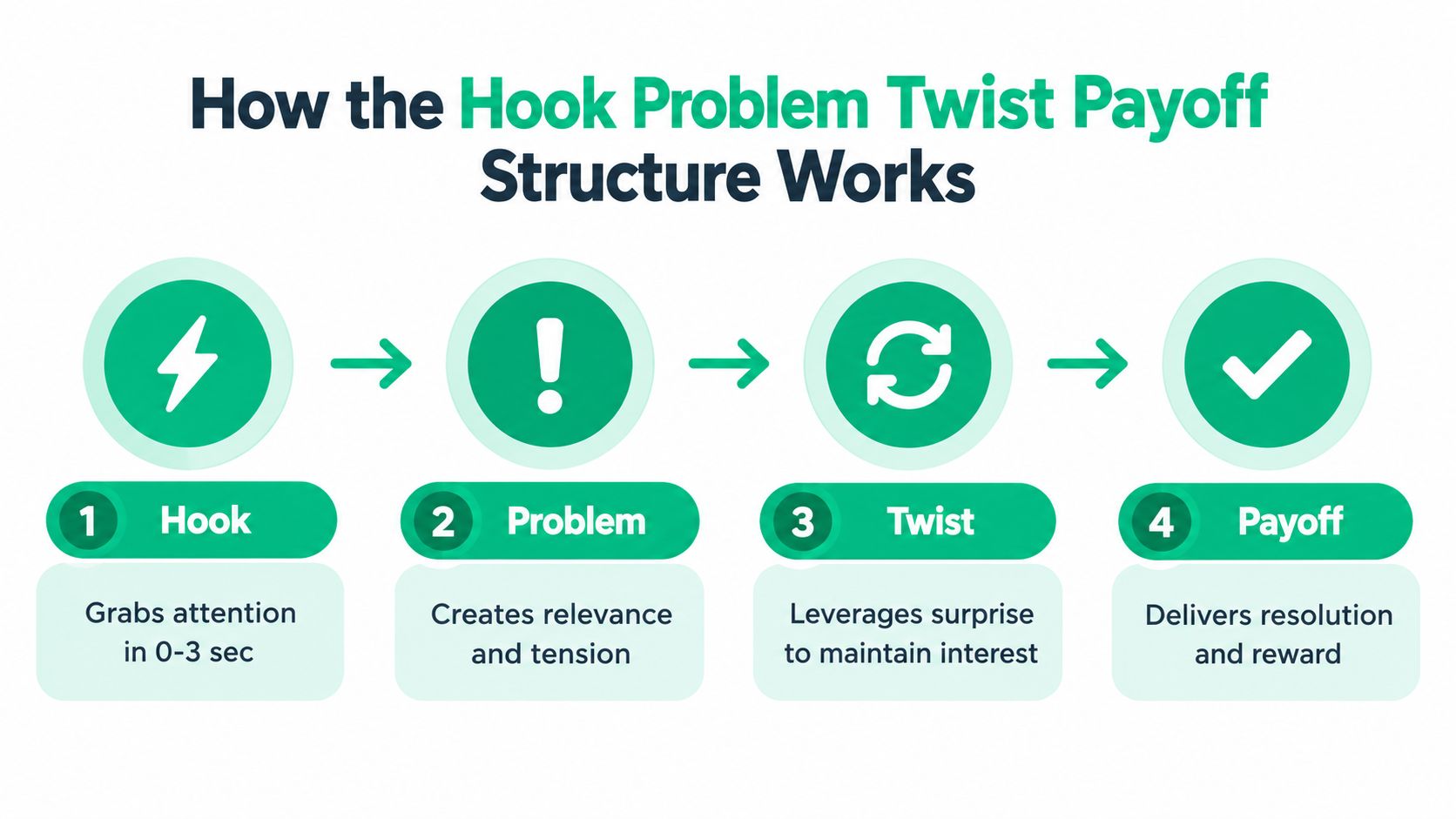
The Hook Method becomes much easier to use when you stop treating it like a slogan and start treating it like a sequence. Strong short-form storytelling often works because each beat earns the next beat.
The opening gets attention. The next moment deepens relevance. Then the video introduces a reframe or surprise. Finally, it delivers the value the opening promised.
Hook
The hook stops the scroll. It can be a challenge, contradiction, reveal, confession, unusual image, or bold caption. Its job isn't to explain the whole video. Its job is to win the next few seconds.
A weak hook says, “Today I'm reviewing a mic.”
A stronger one says, “This tiny mic fixed the one audio problem that made my videos sound cheap.”
The second version creates a payoff cue. It implies there's a specific problem and a practical answer.
Problem
The problem creates relevance and tension. It tells the viewer why this topic matters.
Many creators rush. They move straight from a catchy opener into random details. But the audience still needs orientation. Why should they care? What friction are you solving? What common mistake, pain point, or misunderstanding is on the table?
Examples of problem statements:
- Creators waste time filming content that loses viewers before the point.
- New runners buy shoes based on looks, then deal with discomfort.
- Small business owners post advice that sounds fine but blends into the feed.
The problem doesn't need to be dramatic. It needs to feel true.
Twist
The twist is the part that refreshes attention. It often takes the form of a reversal, surprise, hidden cause, or “many think X, but Y” move.
This beat matters because attention decays. Even after a good hook, viewers need another reason to continue. The twist acts like a second grip point.
For analysis work, that makes the problem-solution structure useful to compare against Hook, Problem, Twist, Payoff. In some videos, the twist is the hinge where the obvious explanation gets replaced with the more useful one.
Payoff
The payoff resolves the curiosity gap. It gives the viewer the reward the earlier beats implied.
That reward can be:
- a tactic
- a demonstration
- a reveal
- a punchline
- a lesson
- a surprising conclusion
Without payoff, the structure feels manipulative. The viewer gave you attention and got no satisfying return.
The easiest way to spot a good short-form script is to ask whether each line buys the next line.
Why order matters
If you put the problem before the hook, many people won't stay long enough to hear it. If you give the payoff before tension exists, the result feels flat. If you tease a twist that never lands, retention often drops because the promise and reward don't match.
This structure also makes videos easier to diagnose. When a clip loses people early, ask which step failed:
| Step | What it should do | Common failure |
|---|---|---|
| Hook | Stop the viewer | Too generic or too slow |
| Problem | Build relevance | Topic is clear, stakes aren't |
| Twist | Renew attention | No surprise or reframe |
| Payoff | Deliver value | Promise made, weak resolution |
That's why the framework is useful for both creators and analysts. It gives you a map, not just a vibe.
The Psychology Behind High Retention Hooks
A hook works because it changes the viewer's mental state fast. It interrupts routine, raises a question, and suggests that staying will be worth it.
That process happens quickly in short-form feeds. One evidence-based framing is that the first 1 to 3 seconds are the critical decision window. A 2026 hook-analysis study classifies hooks as visual, verbal, and textual formats, frames optimization around the first 3 seconds, and recommends testing multiple openings against the same core body so the only variable is the hook (study PDF).

Pattern interruption
Most scrolling is semi-automatic. The thumb moves, the eyes scan, the brain predicts. A hook breaks that prediction.
Pattern interruption can come from:
- a strange visual
- a direct contradiction
- a tone shift
- a bold caption
- a motion cue in the first frame
The brain notices change before it processes detail. That's why a visually distinct opening often beats a polite introduction.
Curiosity gap and payoff cues
Curiosity alone isn't enough. The viewer also needs a reason to believe the answer will be worth getting.
“Don't make this editing mistake” creates a gap.
“Don't make this editing mistake if you want cleaner pacing in talking-head videos” creates a gap with a clearer payoff.
One triggers mild interest. The other gives the audience a practical outcome to evaluate.
Why density beats length
The most useful expert takeaway isn't “make hooks longer” or “make hooks shorter.” It's that strong hooks are usually compressed and multi-modal. One guide says high-performing openings combine a verbal pattern interrupt, on-screen text, and visual motion within roughly the first 2.5 seconds. The same source says a strong spoken hook often fits into about 1.2 to 2.0 seconds, or roughly eight words, and recommends writing 8 to 12 hook variants and keeping the one that survives a mute test or retention comparison (hook structures guide).
That matters because viewers often watch with sound off, partial attention, or both. If the spoken line carries the whole opening, the hook may fail before the meaning arrives.
A dense opening gives the brain three chances to care: what it sees, what it reads, and what it hears.
Types of Hooks and When to Use Each One
Once you stop thinking of the hook as “the opening line,” your options widen. Different hook types solve different feed conditions.
Some audiences scroll with sound on. Some don't. Some niches reward facial expression. Others perform better with clean overlays and object-based visuals. The useful question isn't which hook type is universally best. It's which one best fits the content, audience, and viewing context.
Visual hooks
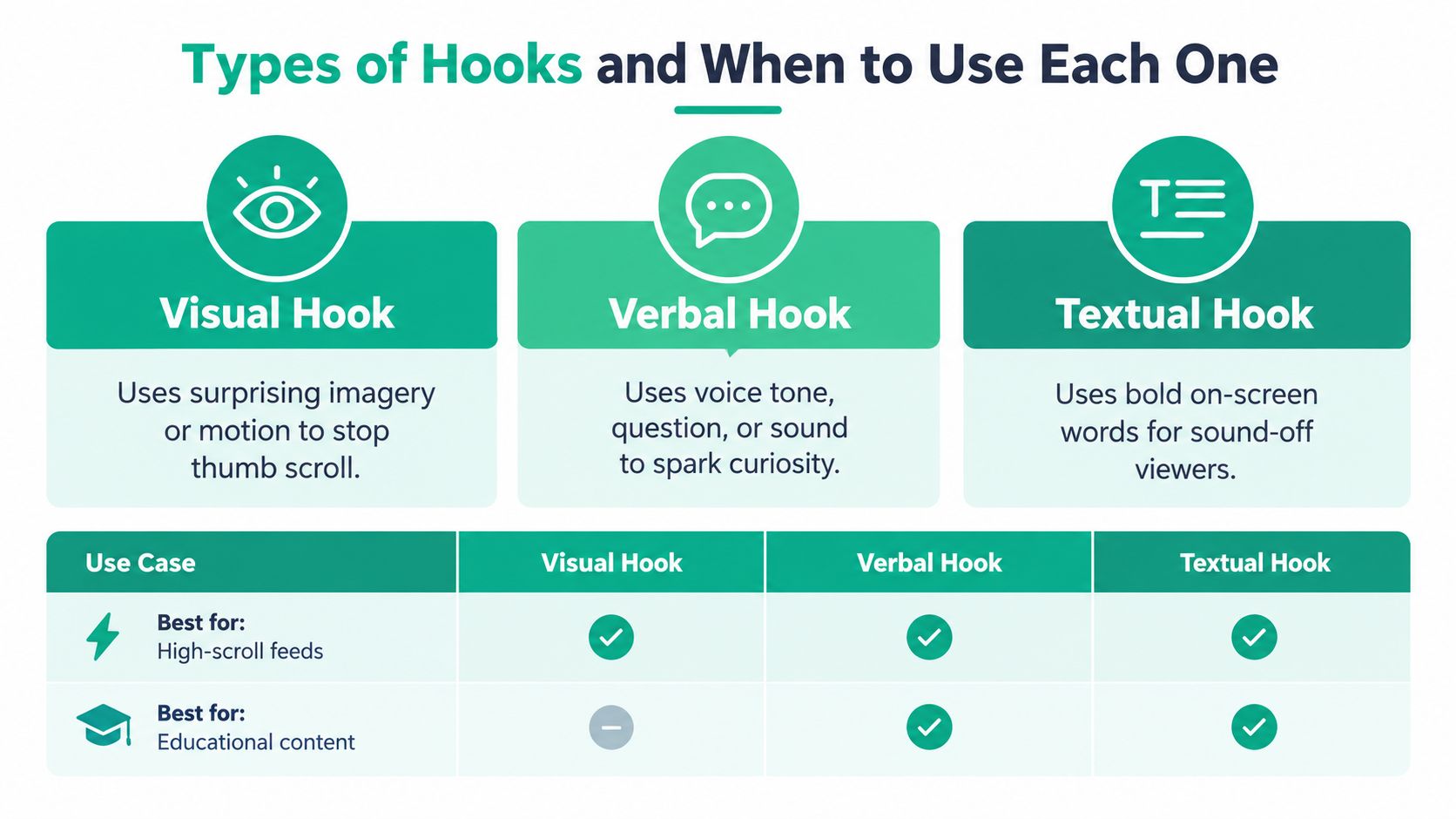
Visual hooks rely on what the viewer sees before they process language. That might be a sudden motion, unusual setup, close-up transformation, object reveal, or facial reaction.
These work well when the image itself carries surprise. A cooking creator lifting the lid off a burnt dish can stop the scroll before a word is spoken. A home office creator showing a cable disaster before the cleanup can do the same.
Risk: visuals can attract curiosity without enough clarity. People may stop briefly, then leave if they can't tell what the video is about.
Verbal hooks
Verbal hooks use spoken language, tone, or pacing to provoke attention. They work well in educational, commentary, and opinion-driven content where the creator's voice is part of the value.
Examples:
- “This advice sounds smart, but it hurts your videos.”
- “I tested the shortcut nobody explains properly.”
- “The part creators copy most is the part that loses viewers.”
Risk: if the line depends too much on audio, it may weaken in sound-off environments.
A useful visual example appears in this embedded clip:
Textual hooks
Textual hooks put the premise directly on screen. Bold captions, short claims, and first-frame text can outperform spoken setups when viewers are moving quickly or watching without sound.
These are especially useful for:
- tutorials
- faceless explainers
- before-and-after transformations
- highly specific niche content
Risk: too much text creates friction. The viewer won't do homework in the first second.
Choosing by context
| Hook Type | How It Works | Best When | Watch Out For |
|---|---|---|---|
| Visual Hook | Stops the thumb with motion, contrast, or an unusual image | The scene itself is surprising or easy to decode | Empty spectacle with unclear relevance |
| Verbal Hook | Uses a line, question, or claim to create tension | Your voice and framing are part of the value | Weak performance in sound-off viewing |
| Textual Hook | States the premise directly with on-screen words | The audience needs fast clarity | Too many words or low-contrast text |
The practical takeaway
You don't need to pick one forever. The underserved question is whether text-based hooks predict engagement better than visual or audio hooks for your audience. The answer usually comes from measurement, not ideology.
A useful workflow is to create the same video body, then swap only the opener:
- Version A: visual surprise first
- Version B: spoken contradiction first
- Version C: bold text-first premise
The winner in one niche may lose in another. That's why “use curiosity” is weaker advice than “compare hook types against the same body.”
Analyzing and Generating Hooks That Actually Retain Viewers
The hook method gets practical when you stop debating taste and start isolating variables. If you change the opening, the pacing, the body, and the ending at the same time, you can't tell what caused the retention shift. If you keep the body identical and change only the hook, you can.
That's the key testing idea behind the 3-second attention gate.
A simple analysis workflow
Start with videos in your niche that clearly hold attention. Pull the transcript. Mark the exact opening words. Note the first frame, on-screen text, and what promise the viewer receives.
Then label the sequence:
- Hook. What stopped the scroll?
- Problem. What made the issue feel relevant?
- Twist. What changed the viewer's expectation?
- Payoff. What reward closed the loop?
If you're studying multiple clips at once, a guide on how to reverse engineer viral videos is useful because it keeps you from reducing everything to “good editing” when the opening architecture is doing much of the work.
What to test
The cleanest tests change only one of these opening variables:
- Opening line: same body, different first sentence
- First-frame visual: same script, different visual interrupt
- Overlay text: same footage, different text premise
That lets you compare retention at the 3-second mark and judge which opener earns the next beat more reliably.
Don't test whole videos against each other if your real question is about the hook. Test openings against the same body.
Write more variants than you think you need
Most creators under-test hooks because the first decent line feels “good enough.” It usually isn't.
A better workflow is to draft a batch of openings before you edit:
- one contradiction
- one direct benefit
- one “mistake” angle
- one curiosity line
- one text-first opener
- one visual-first opener
- several hybrids
Then do a mute test. Can someone understand the premise from the first moments without audio? If not, the hook may be too dependent on spoken explanation.
Tools that make this easier
You can do this manually with a notes app, spreadsheet, and repeated rewatching. You can also use transcript and pattern-analysis tools to speed up the process. TransClipper lets you paste a TikTok, Reel, or Short and get a transcript plus a labeled breakdown of hooks, structure, and calls to action, which is useful when you're comparing many videos and trying to spot repeatable opening patterns.
The point isn't automation for its own sake. The point is reducing guesswork so your creative decisions come from visible patterns.
A repeatable generation loop
Here's a practical loop you can use every week:
- Collect: save short-form videos in your niche that hold attention.
- Extract: pull the transcript and isolate the first moments.
- Label: classify the opener as visual, verbal, textual, or mixed.
- Map: identify where the problem, twist, and payoff occur.
- Generate: write several variants for your own topic using those patterns.
- Test: publish hook variants against an identical body.
- Keep records: save winners in a searchable hook library.
Once you do this repeatedly, your hook writing improves faster because you're no longer starting from a blank page. You're building from observed mechanics.
Putting the Hook Method Into Practice for Your Next Video
The most useful shift is to stop treating the hook like decoration. It's not the spicy sentence at the top of the script. It's the entry system for the entire video.
When creators apply the hook method well, they usually do three things at once. They frame the opening as a 3-second attention gate, they build the video around Hook, Problem, Twist, Payoff, and they test openings as variables instead of trusting instinct alone.
A checklist before you post
Use this quick filter on your next short-form video:
- First-frame clarity: can a viewer tell what kind of promise is being made immediately?
- Multi-modal opening: does the hook work through text, visuals, audio, or at least two of those together?
- Specific relevance: will the right viewer recognize that this is for them?
- Curiosity with direction: does the opener raise a question and hint at the value of the answer?
- Fast resolution path: does the next beat start paying off the curiosity instead of stalling?
- Variant mindset: did you test multiple hooks against the same body?
Build your own hook library
The fastest way to improve isn't writing one genius opener. It's collecting evidence.
Save hooks that worked for your audience. Save the ones that failed too. Note whether they were visual, verbal, or text-led. Note what kind of problem they introduced and how quickly the payoff arrived. Over time, you'll see patterns in your own niche that are more useful than generic internet advice.
If you're producing at a bigger scale or studying polished brand creative, reviewing how best video production companies approach clarity, framing, and visual communication can sharpen your eye. High-end production won't replace a good hook, but it can teach you how professionals make the first moment legible.
A strong hook isn't guessed. It's discovered through comparison, compression, and repeatable testing.
If you want to study hooks without manually replaying every clip, TransClipper can turn TikToks, Reels, and Shorts into transcripts with labeled hook and structure breakdowns. It also helps you compare patterns across multiple videos and generate fresh hook variations, which makes this whole test-and-measure workflow much easier to run consistently.


