
On this page33 sections
Most advice about social media competitor analysis starts with the tool. That's backwards. One platform might benchmark posting cadence and engagement, another might catch brand mentions and narrative shifts, and a third might be the only one that helps you break a single TikTok or Reel into hook, structure, and CTA.
That matters because the category has grown into a major software segment. One market estimate puts social media analytics at USD 10.2298 billion in 2024, projected to reach USD 43.2467 billion by 2030, a 27.2% CAGR from 2025 to 2030. For buyers, that means social media competitive analysis tools now sit inside a mature enterprise buying motion, not a niche add-on.
The practical question isn't “what's the best platform?” It's which research job you need to perform first. Usually that job falls into one of five buckets: benchmarking account performance, finding mentions and share of voice, tracking creators and partnerships, understanding video performance by platform, or dissecting individual Shorts, Reels, and TikToks. Teams doing broader market work often pair this with adjacent functions such as competitive intelligence for pricing teams, because the same rivals shape both messaging and monetization.
This list compares tools by those jobs. I'm looking at platform coverage, reporting, implementation effort, modeled metrics, API gaps, and how well each product fits a lean short-form workflow. If you need clip-level research rather than another dashboard, TransClipper is the outlier here. It focuses on transcripts, hooks, structures, CTAs, and viral mechanics inside individual videos, then lets you scale that analysis across batches.
1. TransClipper
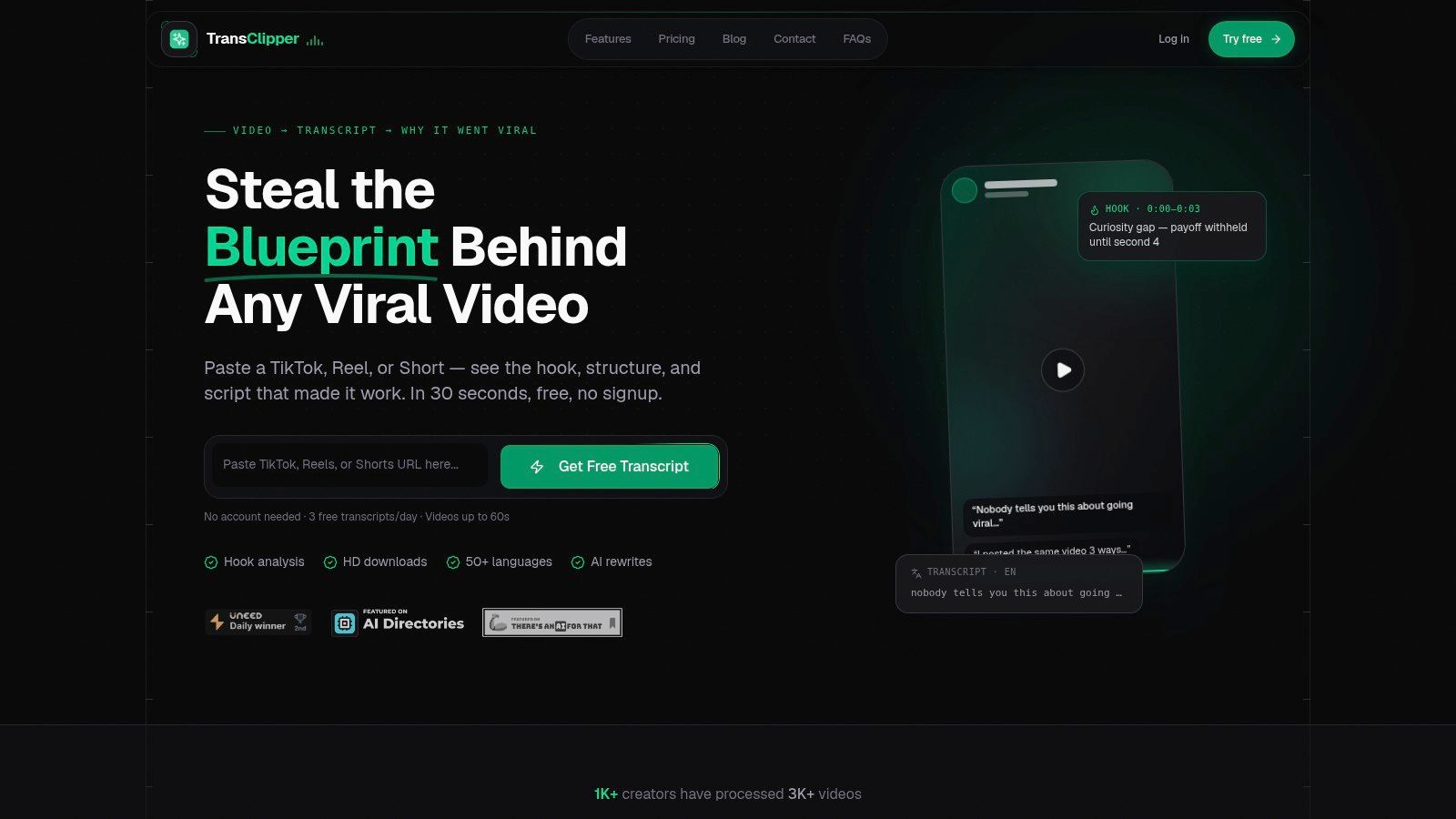
Competitive analysis usually starts too high in the stack. Account dashboards show who is winning. They rarely explain why a specific Reel, Short, or TikTok worked. TransClipper is built for that narrower research job: clip-level pattern discovery.
The product takes a video URL and returns a transcript plus a structured read of the opening hook, narrative sequence, CTA, and timing. That matters for short-form teams because creative performance often turns on details that account-level benchmarking flattens out. If two competitors post at similar volume but one repeatedly wins on retention or shares, the useful question is often inside the script and pacing, not inside another cross-channel leaderboard.
Where it fits best
TransClipper fits after the benchmark step, not before it. A lean workflow looks like this: use a benchmarking tool to identify the outlier posts, move those clips into TransClipper, then compare transcript patterns across a sample large enough to spot repeatable structures. That sequence reduces wasted review time and keeps analysts from reverse-engineering average content.
Its practical value is speed. Analysts can batch videos, search transcripts, sort recurring hooks, and review CTA patterns without manually scrubbing through each clip. Bulk import supports larger review sets, and collection or playlist import makes it easier to study a format, creator, or campaign cluster instead of isolated posts.
The distinction from broader social analytics tools is clear. TransClipper does not try to cover share of voice, brand mentions, or channel-wide benchmarking. It focuses on video intelligence at the unit level. For teams researching Shorts, Reels, and TikToks, that is often the missing layer between a dashboard and a creative brief.
What the workflow supports
The platform combines transcript generation, clip analysis, exports, and asset capture in one workspace. That combination is more useful than a transcript-only utility because the research output can move straight into review decks, swipe files, or scripting workflows. Team roles and shared libraries support collaborative analysis, while the transcript API gives technical teams a way to move outputs into internal systems.
Some of the added AI features are useful, but they should be treated as production aids rather than evidence. Tools such as hook generation, script rewriting, and virality analysis can speed ideation after the research phase. They do not replace analyst judgment, and they should not be confused with observed competitor intent.
Strengths and limits
The strength here is focus. If your research job is clip-level diagnosis, TransClipper is better aligned than an all-purpose social suite. It is especially useful for teams that need to compare many short videos quickly and document patterns with less manual note-taking.
The limits are just as important. It will not answer market-level listening questions or produce a clean competitor benchmark on its own. Transcript quality also depends on source audio and platform conditions, so noisy clips, muted speech, or weak auto-caption inputs can reduce reliability. Analysts should sample outputs for accuracy before drawing strong conclusions from wording or timing patterns.
Pricing is more transparent than in much of the category, with a free tier and paid plans that define usage limits. Even so, buyers should verify current quotas, API access, and export constraints during evaluation because packaging in AI products can change faster than enterprise analytics contracts.
For short-form competitive research, TransClipper fills a specific gap. It helps teams move from “this post outperformed” to “these are the repeatable structural choices inside the post.”
2. Rival IQ
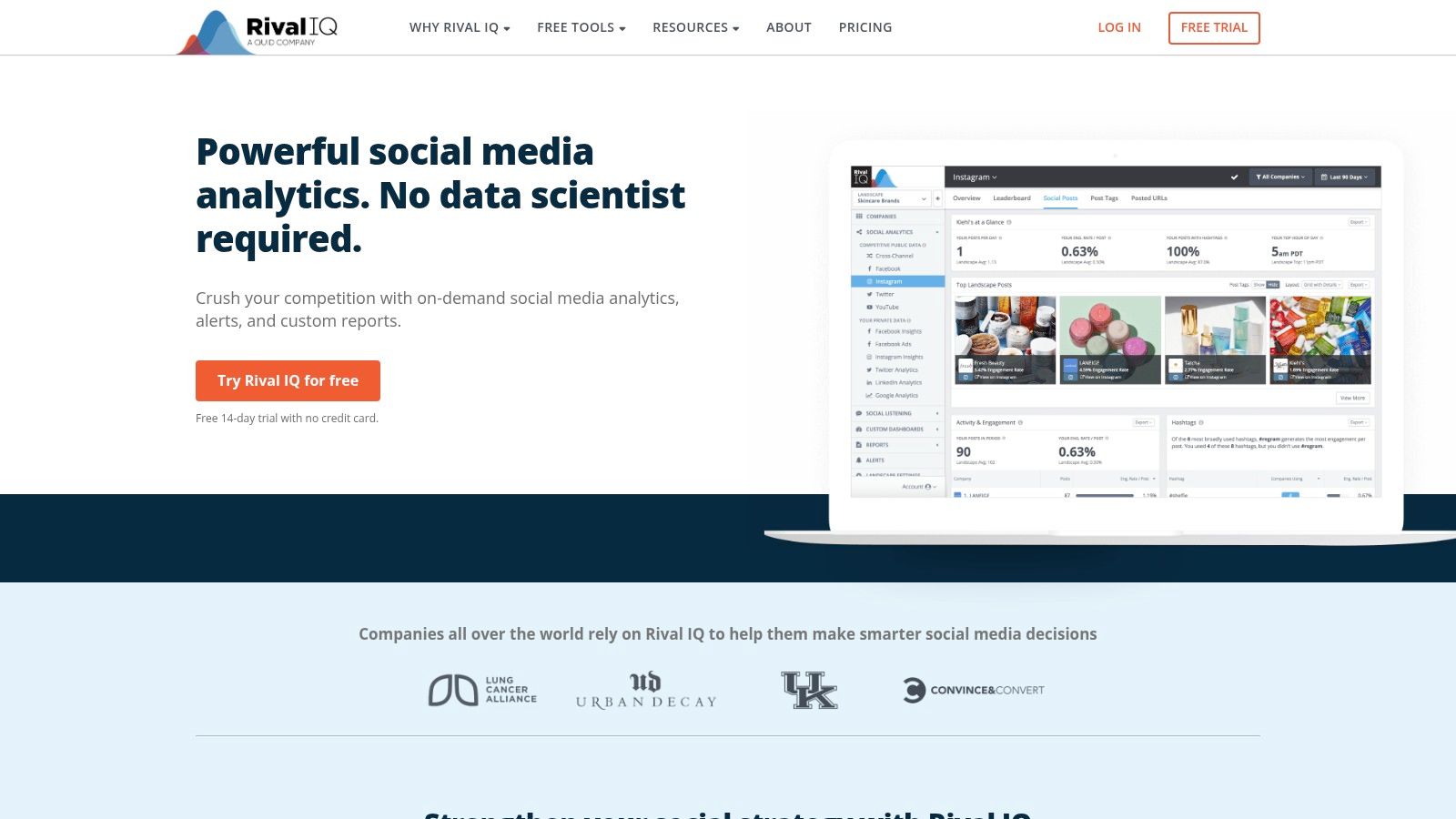
Rival IQ is the cleanest option here for fast benchmarking. If you need to compare a known competitor set across channels, identify top posts, and send stakeholder-friendly reports without heavy setup, it's one of the easiest tools to justify.
Its value isn't that it answers every question. It's that it answers the first question quickly: who's outperforming whom, on which network, and with what kind of post behavior.
Best use case
Rival IQ works well for weekly and monthly benchmark reviews. It combines cross-channel leaderboards, post-level analysis, boosted-post detection, always-on alerts, and scheduled branded reports. For short-form teams, the TikTok-specific competitive coverage is useful because it keeps video programs inside the same reporting habit as other social channels.
The caution is data interpretation. Competitor impressions are estimated rather than first-party, so analysts should treat them as directional, not definitive. That's still useful, but it changes how you present findings internally.
Don't let modeled metrics become executive facts. Use them to prioritize investigation, not to claim exact competitor reach.
If your team often moves from benchmark slides into deeper creative review, Rival IQ pairs well with a clip analysis layer. That's where a workflow like competitor content analysis becomes more valuable than another dashboard tab.
What holds it back
Rival IQ's practical weaknesses are mostly platform-driven. LinkedIn competitive data is limited by API constraints, and Facebook Reels competitive data isn't available. Those aren't product failures so much as reality checks for anyone comparing vendors.
Its website also benefits from transparent public pricing, which is rare enough in this category to matter. Teams that need quick audits can start there, use the free head-to-head snapshot reports, and decide later whether they need a larger stack.
Visit Rival IQ.
3. Socialinsider
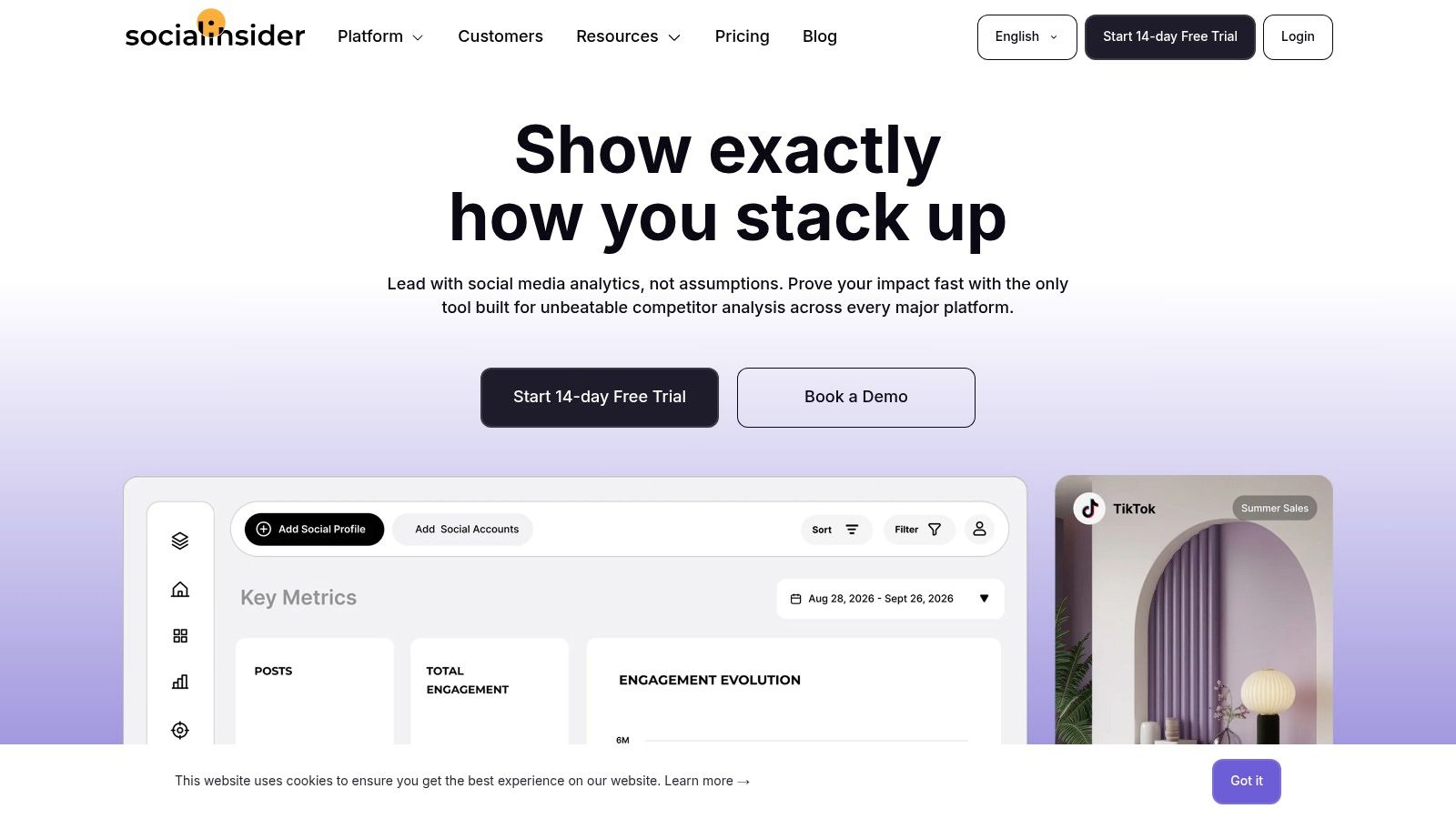
Socialinsider is a strong middle-market pick because it does the obvious work well. It benchmarks competitors across Instagram, TikTok, Facebook, YouTube, LinkedIn, and X without making the analyst fight the interface.
That matters more than most roundups admit. A lot of social media competitive analysis tools have broad coverage but weak day-to-day usability. Socialinsider is better when the team replacing spreadsheets doesn't want a long implementation project.
Why teams pick it
The standout use case is comparative reporting across a manageable account set. You can group competitors, export benchmarks, and review content performance across networks from one place. Agencies also benefit from bulk profile handling, which cuts setup friction when the same reporting structure repeats across clients.
Its AI layer is useful in a narrow way. It can help query data and speed interpretation, but value still comes from the underlying benchmark structure. Teams should treat the AI assistant as an analysis aid, not a substitute for research judgment.
Where caution belongs
Socialinsider still inherits API constraints. One practical example is Facebook followers history only being available from the date the profile is added. That means historical comparisons may look cleaner than they really are if the tracked set was assembled late.
Pricing also scales with total tracked accounts, so larger competitor sets require plan math before rollout. For agencies and multi-brand teams, that can matter more than the base feature list.
The product is best for straightforward benchmarking workflows. It's less compelling if your main need is broad listening, creator market mapping, or clip-level short-form analysis.
Visit Socialinsider.
4. quintly (Facelift Data Studio)
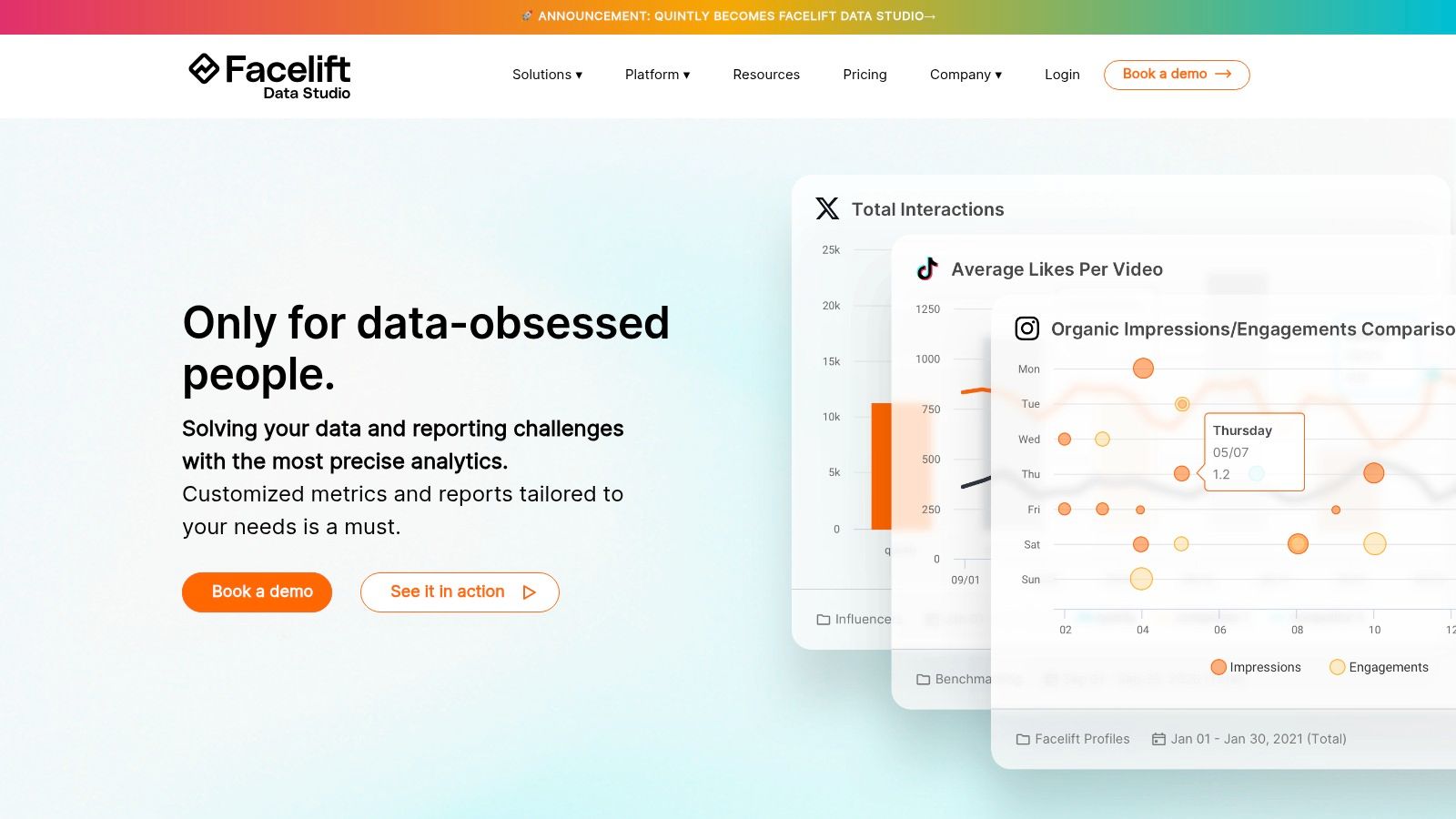
quintly is what you choose when predefined dashboards start to feel restrictive. Analysts, BI-minded marketing teams, and enterprise reporting functions often will.
Its differentiator is custom metric construction through quintly Query Language. That's not a small detail. It changes the product from “benchmarking software” into something closer to an analytics workbench for social data.
Best fit for custom KPI work
If your reporting logic is unusual, quintly becomes more attractive. You can build custom KPIs, automate reporting, and benchmark large profile sets across multiple networks, including TikTok. It also offers API access, which helps when social analysis has to flow into broader data infrastructure.
For organizations building internal scorecards, that flexibility is the point. You're not forced into the vendor's default definition of what matters.
Tradeoffs
The downside is predictable. Flexibility raises the learning curve. Teams that don't have analysts comfortable with custom metrics may pay for power they never operationalize.
There's also a procurement signal worth noting. In this category, software dominates buying preference, with solutions accounting for roughly 64% to 66% of revenue in the social media analytics market. quintly fits that preference well because it behaves like configurable software, not a services-heavy deployment.
Its website suggests a short trial, but larger packages are sales-led. That makes quintly more suitable for serious evaluation than casual experimentation.
Visit quintly.
5. Sprout Social
Sprout Social is less a pure competitor tool than a social operating system with competitive analysis built in. That distinction matters. If your team wants publishing, engagement, governance, analytics, and listening in one environment, Sprout can make more sense than stitching together point solutions.
It's especially useful when social teams need competitor data inside the same place they already work. That reduces reporting handoff friction, which is often a bigger operational problem than missing a niche metric.
Where it earns its place
Sprout's core competitive layer includes Competitor Performance Reports and per-network benchmarking. Its Listening product extends that into topic tracking, competitor mentions, narrative shifts, and sentiment, though listening is a separate add-on rather than a default capability.
That separation is important in budgeting discussions. A buyer comparing feature lists may assume listening is part of the standard package when it isn't. If your workflow depends on mention monitoring and narrative analysis, validate the exact package early.
For content teams, Sprout becomes stronger when paired with a more detailed inspection method for the posts that matter. A workflow built around social media content analysis can prevent benchmark reports from staying too abstract. Teams that want a broader publishing layer but are comparing alternatives may also look at social scheduling without Sprout Social.
Constraints to keep in mind
Sprout's limitations are the familiar ones in this market. LinkedIn competitive data isn't available because of API restrictions, and per-seat pricing can become expensive as more stakeholders need access.
That said, its end-to-end operating model is compelling. Enterprise collaboration, approvals, custom reports, and automated delivery make it attractive for organizations where social analysis has to pass through brand, legal, regional, or client-facing review.
Visit Sprout Social.
6. Brandwatch
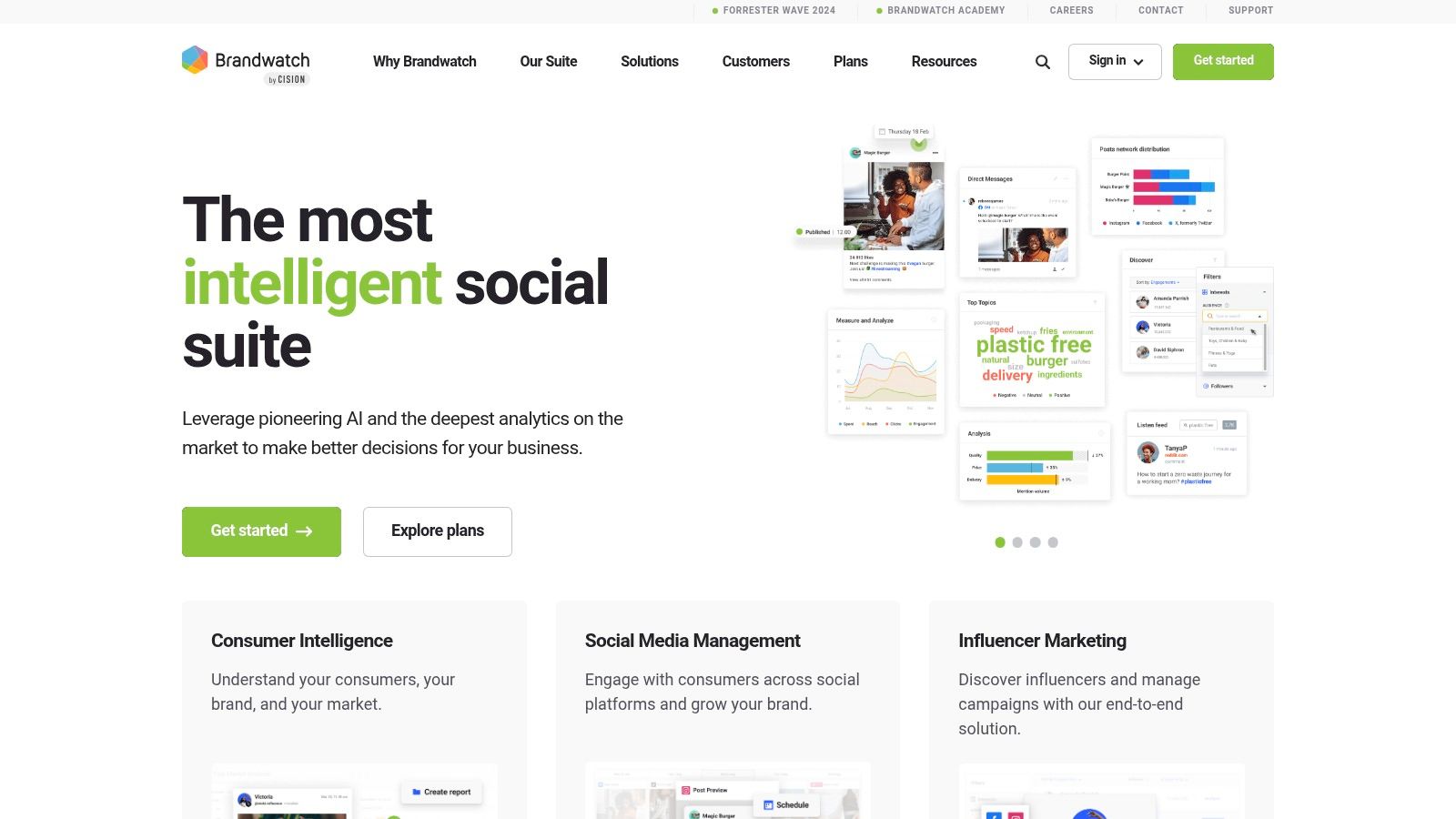
Brandwatch is the listening-first option for organizations that care as much about narrative position as performance benchmarking. It's built for teams asking harder questions: who owns the conversation, which themes are rising, and how does our brand compare with a much larger market set than the handful of logos in our standard dashboard?
That's why Brandwatch tends to show up in enterprise research stacks rather than lightweight social teams.
Best for narrative competition
Its Benchmark product compares performance against a very large brand database, and its Consumer Research side digs into conversation themes, share of voice, and broader competitive narratives. That's a different job from simple account comparison.
If a competitor launches a new positioning line, changes creator strategy, or triggers a reputation issue, Brandwatch is built to surface those shifts. Teams working across PR, social, and influencer programs get the most value because the data supports all three functions.
Why smaller teams hesitate
The platform usually comes through enterprise contracts, not public list pricing. For a smaller team that only needs account-level benchmarks, that can feel like buying an intelligence department when you really needed a reporting tool.
Another signal supports that enterprise fit. In several forecasts, North America remains the largest regional market, with a 33.0% to 39% share in 2025, while large enterprises represent 58.9% of market share in one estimate. Brandwatch aligns closely with that upper-market buying pattern.
Use it when your competitive problem is market narrative, issue detection, and strategic monitoring. Don't use it if your real need is to compare six rivals on TikTok and Instagram.
Visit Brandwatch.
7. Emplifi (formerly Socialbakers)
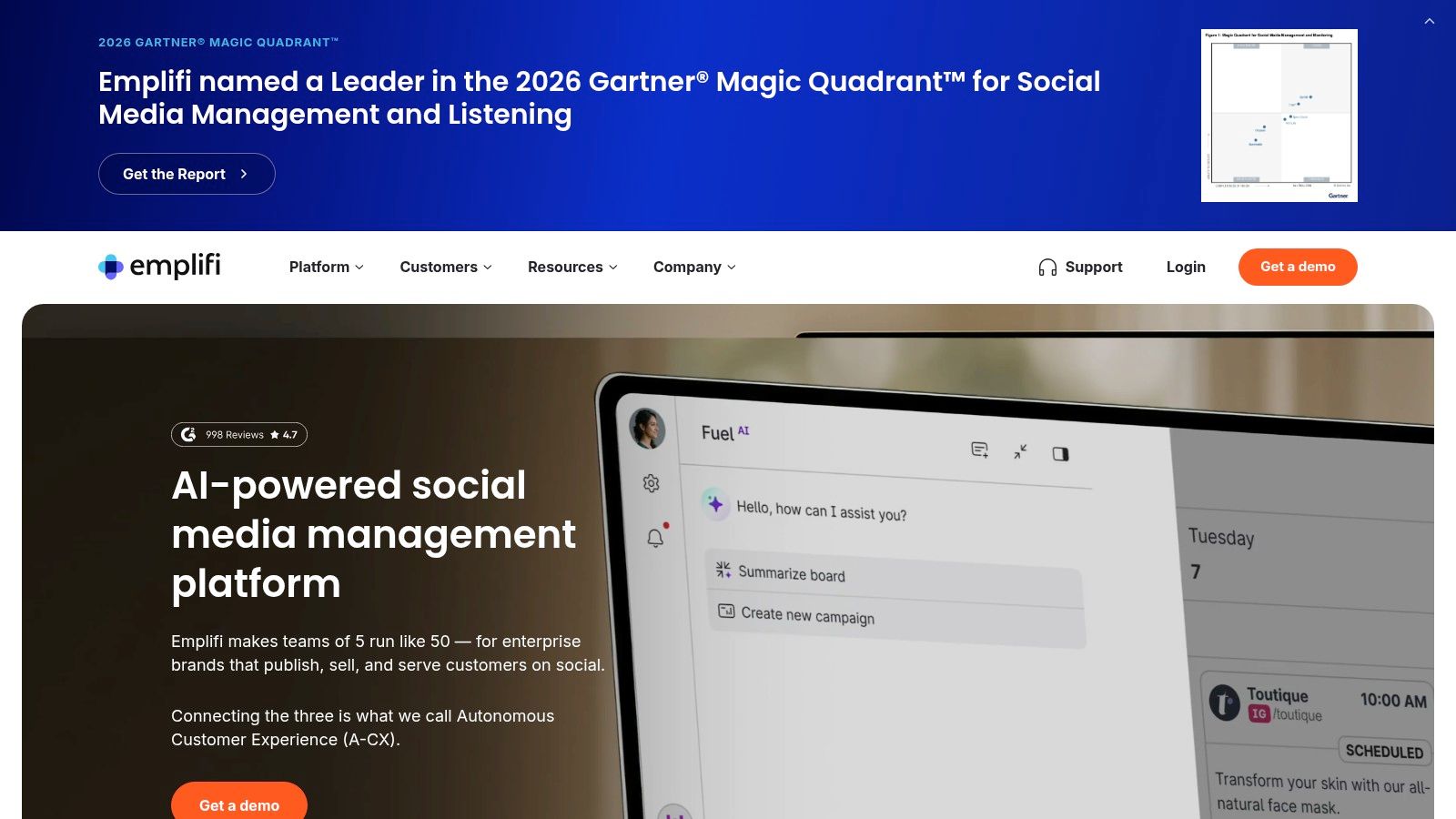
Emplifi makes the most sense when competitive analysis sits alongside social commerce, paid context, and customer care. That broader frame is its real advantage. Some teams don't just want to know which competitor post performed best. They want to place that performance beside service signals and commercial activity.
That's why agencies and enterprise social operations often keep Emplifi on the shortlist.
Strongest workflow
Unified Analytics is the anchor. It centralizes performance reporting, benchmarking, dashboards, and automated reporting in a way that suits multi-brand and multi-client use. The product also supports social listening sources and comparison views, with TikTok included in analytics modules.
This creates a fuller picture than benchmark-only tools. If a competitor appears to be winning attention, Emplifi gives more room to ask whether that edge is tied to organic content, paid support, or broader customer-facing execution.
Main compromises
The obvious tradeoff is cost and complexity. Pricing is sales-led and generally positioned upmarket. Smaller teams can find themselves paying for a platform model they won't fully use.
There are also some historical backfill limits in areas such as TikTok or Instagram hashtags. That doesn't make the tool weak. It means analysts should confirm what history is available before promising retrospective work.
Emplifi is a better fit for organizations that treat social as an integrated operating function. If all you need is lightweight benchmarking, there are simpler options.
Visit Emplifi.
8. Storyclash
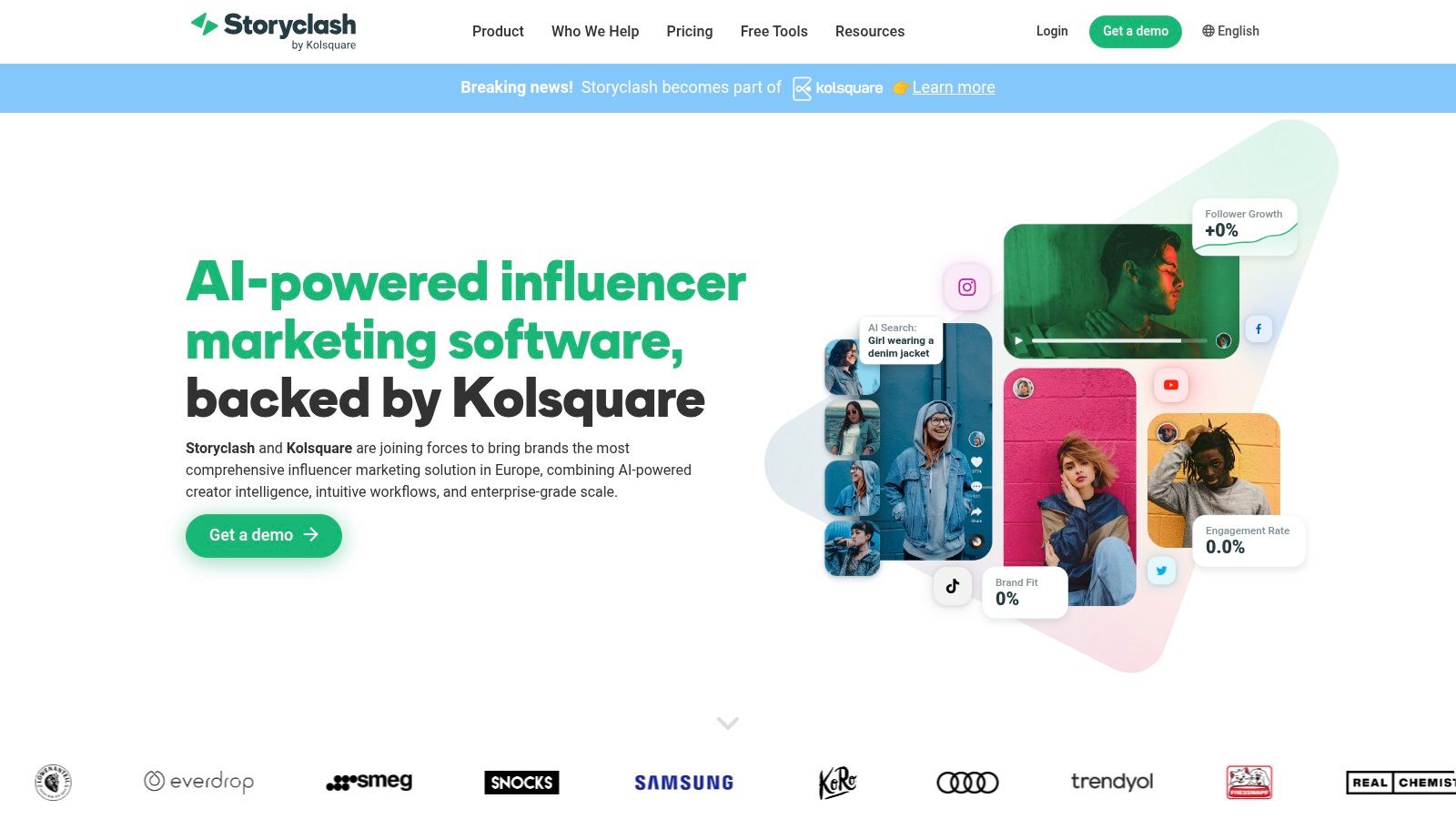
Storyclash enters the problem from the creator side. That makes it especially useful for brands whose competitors rely heavily on influencer seeding, creator whitelisting, or recurring short-form collaborations.
A standard benchmarking suite may show that a rival's video output is surging. Storyclash is better for answering who helped create that surge.
Best for creator tracking
The platform focuses on market and competitor insights across Instagram, TikTok, and YouTube. You can track creators mentioning competitors, monitor campaign activity, compare cross-platform KPIs, and review shareable dashboards. The archived Instagram Stories layer is also valuable because Stories are easy to miss in manual research.
For short-form teams, this fills a common blind spot. Competitor performance isn't always coming from the brand account itself. Sometimes the distribution engine sits in a network of creators.
The fastest way to misread a competitor's strategy is to study only their owned channels.
What to watch for
Storyclash is more creator- and collaboration-centric than broad listening tools. That's a strength when creator tracking is your actual job, but it can disappoint teams expecting a complete social intelligence suite.
Pricing is also customized rather than public, so qualification usually happens through a sales conversation. If your workflow depends on influencer mapping and partnership benchmarking, that friction is usually worth it. If not, it may be more tool than you need.
Visit Storyclash.
9. Tubular Labs
Tubular Labs is the most video-specialized enterprise platform on this list. If your organization treats YouTube, TikTok, Instagram video, Facebook video, or even Twitch as a category intelligence problem rather than a social reporting task, Tubular is in its own lane.
Its strength isn't generic social coverage. It's category-level video intelligence and audience patterning.
Why video teams choose it
Tubular works well for audience-development teams, media companies, sponsorship groups, and brands making large video programming decisions. It supports competitive benchmarking, creator discovery, category insight, and cross-platform video performance analysis.
It separates from standard social media competitive analysis tools. Instead of just comparing brand accounts, it helps teams understand the broader video environment they're competing inside. That can shape editorial priorities, partnership choices, and distribution bets.
If your team also needs to study the construction of standout clips after identifying them, a second layer such as content analysis tools for short-form video can make the workflow more actionable.
Limits
Tubular is enterprise-oriented and custom-priced. It's also optimized for video, so text-first listening and general brand mention work are better handled elsewhere.
That specialization is a feature, not a flaw. But buyers should be honest about their center of gravity. If the work is mostly social publishing and stakeholder reporting, Tubular may be overbuilt. If the work is competitive video strategy, it's one of the most relevant options available.
Visit Tubular Labs.
10. Keyhole
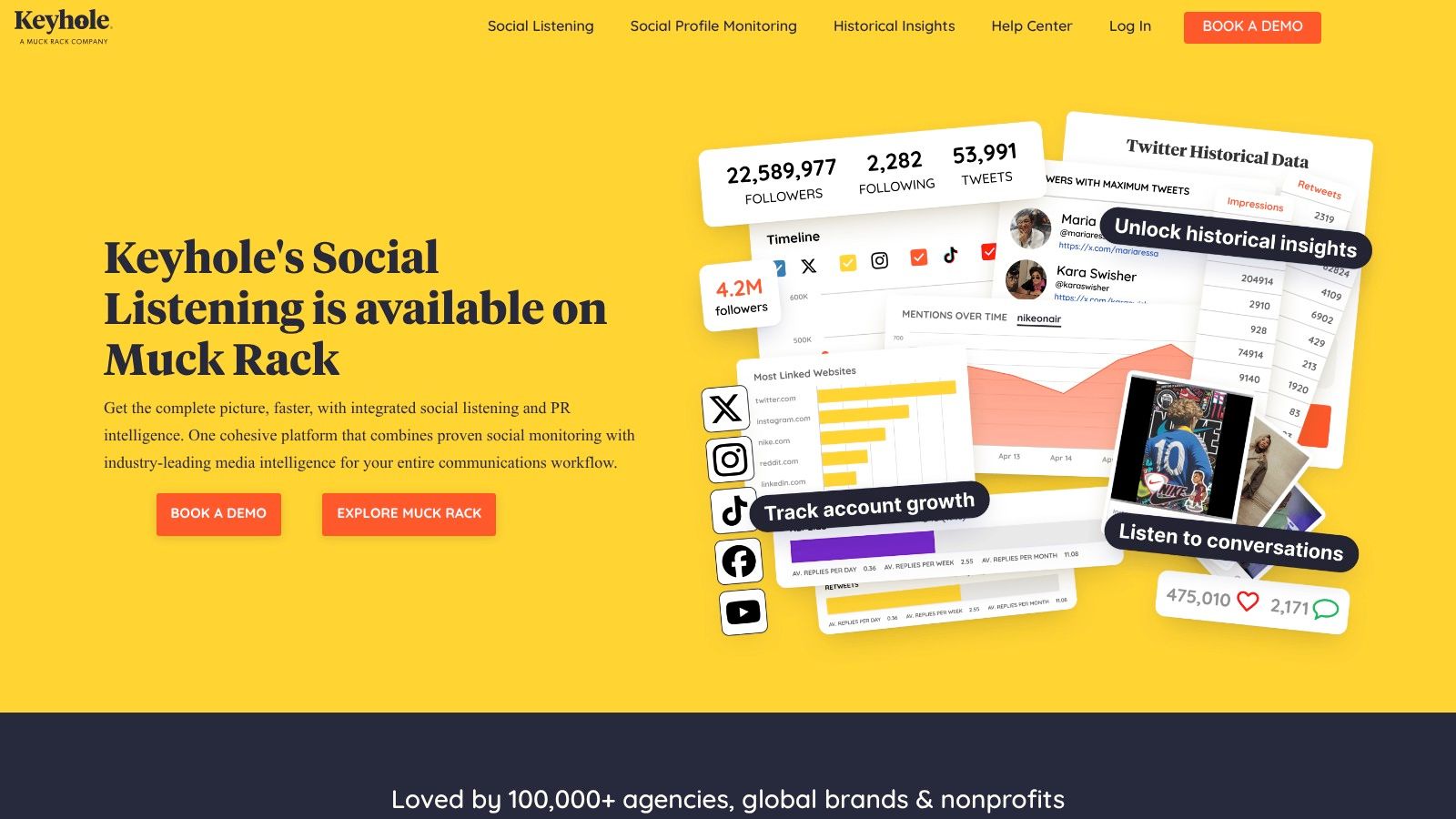
Keyhole is a practical tool for smaller teams that want competitor benchmarking, hashtag tracking, and some influencer analytics without moving into a full enterprise suite. It's the kind of product that often gets bought because it can answer several mid-level questions reasonably well.
That versatility makes it a useful bridge tool.
Best use case
Keyhole is strongest when the team needs quick setup and real-time monitoring. It supports competitor comparison groups, hashtag and keyword tracking, sentiment and trend breakdowns, influencer discovery, campaign analytics, and TikTok profile analytics.
The product is particularly helpful for campaign-era research. If you're tracking a competitor launch, a shared hashtag, or a creator-driven burst of short-form content, Keyhole can centralize the watchlist quickly.
Where it stops
The tradeoff is depth. Listening archives and coverage are typically lighter than enterprise platforms, and some advanced history or tracker capacity can sit behind add-ons. Costs can rise as tracking scope expands.
That said, its mixed capability set reflects a broader market reality. Social listening adoption is already mainstream. One industry summary reports that 76% of marketing professionals globally use social listening software, another 17% are evaluating it, and 78.5% of listening teams use more than one platform. Keyhole makes sense in that kind of stack because it can cover benchmarking, monitoring, and campaign tracking without forcing an enterprise commitment.
Visit Keyhole.
Top 10 Social Media Competitive Analysis Tools, Features Comparison
| Product | Core features | UX / Quality (★) | Value & Pricing (💰) | Target audience (👥) | Unique selling points (✨) |
|---|---|---|---|---|---|
| 🏆 TransClipper | Instant multilingual transcripts, hook/structure/CTA breakdowns, AI agents, bulk import, HD watermark‑free downloads, searchable library | ★★★★★ Fast (5–30s); accurate; platform-aware | 💰 Free tier; Pro $7.42/mo; Business $16.58/mo (annual) | 👥 Creators, social teams, agencies | ✨ Short-form focused analysis + AI ideation + HD asset capture |
| Rival IQ | Cross-channel benchmarking, post-level analysis, boosted-post detection, alerts & scheduled reports | ★★★★ Clear dashboards; fast benchmarks | 💰 Transparent plans; free head‑to‑head reports | 👥 Brands & agencies needing competitor benchmarks | ✨ TikTok-specific competitive analytics & leaderboards |
| Socialinsider | Competitor benchmarks, cross-platform tracking, AI assistant, bulk profile reporting | ★★★★ Clean UX; easy onboarding | 💰 Pricing scales with tracked accounts | 👥 Mid-market agencies & brand teams | ✨ AI query layer + exportable competitor reports |
| quintly (Facelift Data Studio) | Custom metrics (qQL), large-scale benchmarking, API, frequent data refresh | ★★★★ Very flexible; learning curve for qQL | 💰 Sales‑led pricing; short trial | 👥 Analysts & data teams | ✨ qQL metric builder for custom KPIs and dashboards |
| Sprout Social | Publishing, engagement, competitor reports, Listening add‑on, custom reports | ★★★★ Polished enterprise UX; collaboration features | 💰 Per‑seat pricing; Listening is add‑on | 👥 Teams needing end‑to‑end social ops | ✨ Integrated social ops + reporting + listening |
| Brandwatch | Enterprise listening, benchmark vs 300k+ brands, AI summarization, PR integrations | ★★★★ Enterprise‑grade depth; complex setup | 💰 Enterprise contracts (no public pricing) | 👥 Large enterprises, PR & insight teams | ✨ Deep listening & industry‑level benchmarking |
| Emplifi | Competitive benchmarking, Unified Analytics, reporting, social commerce & care context | ★★★★ Scalable dashboards for multi‑brand teams | 💰 Sales‑led; positioned upmarket | 👥 Enterprises & agencies focused on commerce | ✨ Combines organic, paid & care metrics in one view |
| Storyclash | Influencer/creator analytics, campaign tracking, cross‑platform KPI tracking, Stories archive | ★★★★ Creator‑centric insights; time‑saving | 💰 Tailored/quoted pricing; entry tiers may gate features | 👥 Brands & agencies benchmarking creators | ✨ Visibility into creator strategies & 12‑month Stories archive |
| Tubular Labs | Cross‑platform video intelligence, creator discovery, category & audience benchmarks | ★★★★ Best‑in‑class video insights; enterprise focus | 💰 Enterprise pricing | 👥 Content strategists, audience development & sponsorship teams | ✨ Video‑first category benchmarks & creator discovery |
| Keyhole | Real‑time analytics, hashtag/keyword monitoring, influencer metrics, TikTok profile analytics | ★★★☆ Quick setup; lighter archives than enterprise suites | 💰 Pricing/add‑ons scale with scope | 👥 Small‑to‑mid teams needing fast monitoring | ✨ Fast hashtag + influencer + campaign monitoring |
Build a Two-Layer Competitive Research Stack
The wrong way to buy social media competitive analysis tools is to search for the one platform that does everything. They don't need one platform. They need a stack with a clear division of labor.
Use benchmarking platforms such as Rival IQ, Socialinsider, or quintly when the question is comparative performance. They're built to show which accounts post more often, which channels outperform, and which content clusters are rising or fading. Use listening-heavy platforms such as Brandwatch, Sprout Social with Listening, Emplifi, or Keyhole when the question is about mentions, share of voice, topic shifts, or reputation signals. Use creator-focused platforms such as Storyclash when competitive action happens through partnerships rather than owned channels. Use video intelligence platforms such as Tubular Labs when the category itself is video-led and audience behavior matters as much as brand output.
Then add a second layer for clip-level inspection.
That second layer matters because most short-form research fails at the exact point where strategy becomes creative. Teams can tell that a competitor is winning on TikTok or Reels, but they can't explain why one hook pattern repeats, why one CTA style appears often, or how a brand structures tension and payoff across multiple clips. TransClipper or a similar clip-analysis workflow complements, rather than replaces, account-level software.
A lean process works better than a sprawling one. Start by collecting a representative set of competitor videos from the accounts and campaigns that matter. Don't rely on one standout clip. Pull several examples across time so you can compare repeated behaviors rather than isolated wins. That timing issue is important because recent guidance argues that quarterly audits miss shifts in posting cadence, format mix, and engagement dynamics, and that continuous monitoring with monthly check-ins produces a more accurate picture of competitive change over time, as discussed in Later's guidance on social media competitive analysis for 2026.
From there, inspect the clips for hooks, structures, CTA patterns, and recurring formats. Validate patterns across multiple examples before turning them into strategy. A single successful video might reflect distribution luck, paid support, or platform context you can't fully observe.
Also document the limits of your data. Some platforms rely on modeled impressions. Some networks restrict competitor visibility through APIs. Historical availability may begin only when an account is added. Pricing often scales with tracked accounts, seats, or listening volume. Those constraints don't make the tools bad. They shape how confidently you can answer each research question.
The best stack is usually the smallest one that answers the questions your team has. If you need broad market narrative, buy for listening depth. If you need creator intelligence, buy for collaboration tracking. If you need to understand why a short-form video worked, add clip-level analysis. For many teams, that combination will produce better insight than a larger, more expensive platform that still leaves the creative logic hidden. Teams exploring broader AI-led research combinations may also look at Sight AI competitive analysis.
If your competitor research keeps stopping at account dashboards, TransClipper fills the gap at the clip level. It lets you analyze TikToks, Reels, and Shorts for transcripts, hooks, structures, CTAs, and repeatable viral mechanics, then organize that work in a searchable research library. Visit TransClipper if you want short-form competitive analysis that helps you study what winning videos do.


