
On this page17 sections
You've probably had this experience: you watch a competitor's Short three times, pause every few seconds, and still can't explain why it held attention. The opening sounds simple, the edits look ordinary, and the call to action arrives before you've identified the structure. Meanwhile, another clip in the same niche appears to have similar ingredients but barely moves.
Video content analysis AI turns that frustrating manual process into a structured investigation. Instead of treating a video as one opaque file, it examines its visual, audio, spoken, and metadata layers, then connects them to moments such as hooks, scene changes, narrative turns, and calls to action. The result isn't a magic explanation for virality. It's a research surface that helps you test better explanations.
What Video Content Analysis AI Actually Does
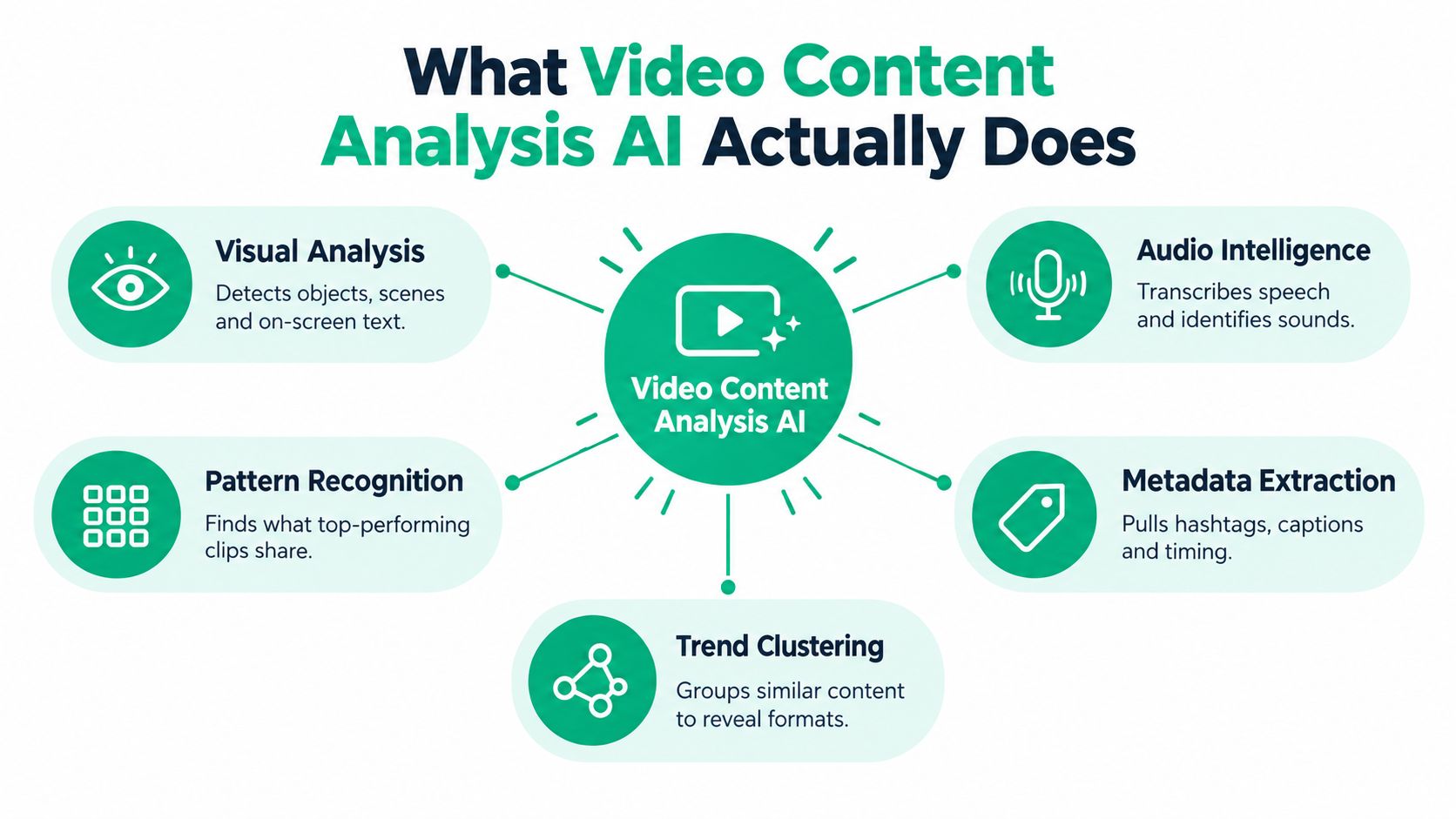
At its simplest, video content analysis AI watches and reads a clip on your behalf. A set of machine learning models samples the video into frames, processes the audio, transcribes speech, identifies scenes and objects, reads visible text, and combines those observations into a usable record.
That matters because a short-form video communicates through several channels at once. A creator may say, “You're making this mistake,” while an oversized caption shows the mistake, a quick cut reveals the result, and a sound effect marks the reveal. A frame-only tool sees some of that visual activity. A transcript-only tool understands the sentence. A multimodal system can connect the spoken claim with the visual proof and the timing.
For a practical introduction to how visual AI systems interpret images, these Vertex AI visual examples offer useful context. The important distinction is that video analysis extends image understanding across time, speech, and sequence.
What you actually receive
A useful system turns raw observations into outputs you can act on:
- Timestamped transcript: Shows exactly when each spoken line appears.
- Scene and visual tags: Records objects, settings, on-screen text, and notable changes.
- Structural labels: Separates the opening hook, problem, twist, payoff, and CTA where the evidence supports those labels.
- Pacing signals: Highlights dense speech, rapid cuts, pauses, and moments where the visual rhythm changes.
- Searchable metadata: Makes captions, hashtags, transcript phrases, and extracted themes easier to compare across a library.
The goal isn't to auto-edit your clip or replace your creative judgment. It's to make the video's mechanics visible. Once you can search a group of clips for question openings, fast reveals, repeated objections, or closing CTAs, research becomes less dependent on memory and more grounded in observable structure.
How the Analysis Pipeline Works from Frame to Insight
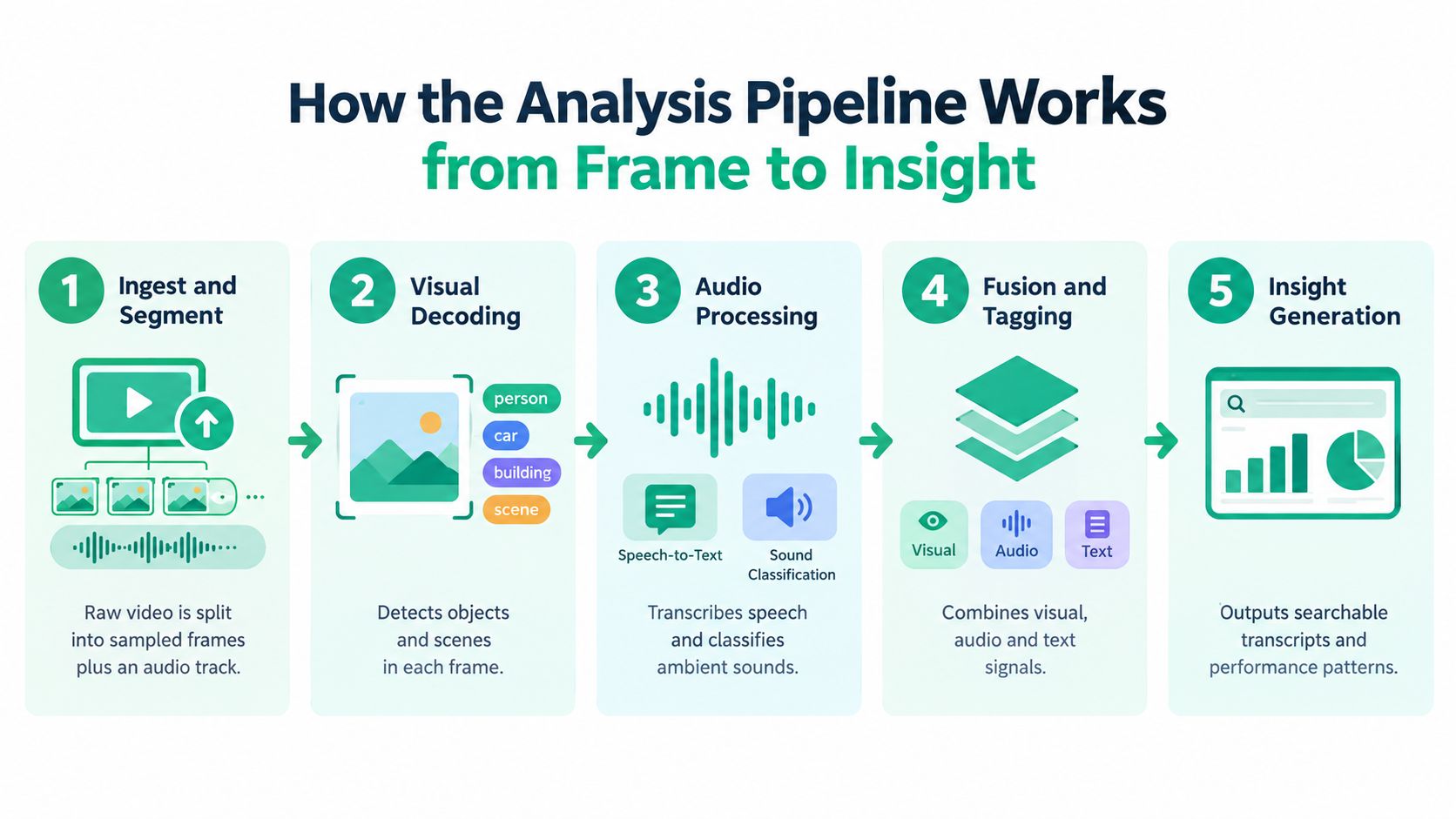
Think of the pipeline as reading a film several times, with each pass adding a different lens. The first pass handles the file itself. Later passes interpret what appears, what's said, and how those signals line up.
Stage one begins with separation
The system ingests the raw video and separates it into sampled visual frames and an audio track. It also preserves timing, because “the creator shows the result after the explanation” is a different finding from “the creator shows the result before the explanation.”
Next, computer vision examines the frames. It can identify scene changes, objects, people, movement, and visible words. Optical character recognition is especially useful when a creator places the key promise in a caption rather than saying it aloud.
The audio pass runs separately. Speech recognition creates a transcript with time alignment, while sound analysis can distinguish speech from music, effects, or silence. If you need the foundational process in more depth, this guide to automated video transcription explains why timing matters as much as the words themselves.
The useful layer is fusion
The system then aligns the transcript with frame-level events. That alignment lets it identify relationships such as:
- The phrase “watch what happens” followed by a visual reveal.
- A question appearing as both spoken dialogue and on-screen text.
- A product demonstration beginning immediately after a problem statement.
- A CTA arriving after the payoff instead of interrupting it.
Structural analysis sits on top of those aligned signals. It can mark an opening, detect a change in tension, identify a payoff, and locate a CTA. Some tools also present a pacing curve, word density, scene-change pattern, or time-to-value estimate.
A creator doesn't need to inspect the underlying model calls. They need a result they can skim: the hook begins at the first timestamp, the problem appears shortly afterward, the visual proof arrives at the next beat, and the CTA asks viewers to save the video. That is the path from pixels and waveforms to a scriptable insight.
Models, Signals, and the Metrics That Matter
Three model families usually contribute to a useful analysis. Computer vision models inspect frames. Speech and language models interpret audio and words. Multimodal fusion models connect those observations into a description of how the clip works as a sequence.
Computer vision is strongest when the answer lives in the image. It can detect a change of setting, a close-up, a product, an expressive face, a text overlay, or a rapid visual transition. Speech and language models handle transcription, speaker changes, keyword density, sentiment, and verbal patterns such as questions, warnings, or pattern interrupts.
Fusion is where creator-facing interpretation begins. A system can compare what the speaker says with what the viewer sees, notice when B-roll supports an explanation, and identify whether a jump cut accompanies a new idea. It can also distinguish a spoken CTA from a visual prompt such as “follow for part two.”
| Model Family | Signals Extracted | Creator Metric |
|---|---|---|
| Computer vision | Scenes, objects, faces, motion, on-screen text | Scene-change rate, visual hook presence, text visibility |
| Speech and language | Transcript, speaker turns, sentiment, keywords, trigger phrases | Words per minute, question-hook frequency, verbal CTA detection |
| Multimodal fusion | Visual-verbal alignment, jump cuts, B-roll, narrative turns | Hook strength, pacing pattern, emotional arc, narrative completeness |
These metrics are useful only when you understand what they can and can't predict. Hook strength describes whether the opening creates an immediate reason to continue. Words per minute shows verbal pressure, but it doesn't prove that faster speech improves retention. Scene-change rate describes visual movement, while narrative completeness asks whether the clip delivers the outcome it promised.
For a broader workflow around examining posts, themes, and competitive signals, social media content analysis provides a helpful companion perspective. Use metrics as prompts for inspection, not as replacements for audience evidence.
Frame Analysis versus Transcript-Backed Structure Analysis
Frame analysis and transcript-backed structure analysis answer different questions. The first asks, “What appears on screen, and when does it change?” The second asks, “What argument or story does the speaker build, and how does each beat lead to the next?”
That distinction matters in a clip that opens with a creator saying, “Stop doing this before you post.” A frame model may detect a face, a room, a caption, and a hand gesture. A transcript-backed system can identify the warning as the hook, locate the explanation, and show whether the creator pays off the warning with a specific alternative.
| Dimension | Frame Analysis | Transcript-Backed Structure Analysis |
|---|---|---|
| Primary evidence | Pixels, objects, scenes, motion, visible text | Spoken words, timing, narrative sequence |
| Strongest use | Visual hooks, cuts, demonstrations, overlays | Hooks, problems, twists, payoffs, CTAs |
| Main blind spot | Spoken logic and causal explanation | Silent visual storytelling and music-led emotion |
| Best question | “What changes on screen?” | “How does the message progress?” |
| Short-form value | Reveals visual pacing and proof moments | Reveals the script skeleton behind retention |
Transcript-backed analysis often has an advantage for short-form research because creators commonly state the hook, promise, objection, or CTA aloud. It still can't fully explain a wordless reaction, a visual transformation, or a beat that depends on music. A hybrid approach gives you the clearest interpretation.
Long-video benchmarks reinforce why sequence matters. ALLVB combines 9 video-understanding tasks, covers 1,376 videos across 16 categories, averages nearly 2 hours per video, and includes about 252,000 questions, as described in the ALLVB benchmark paper. A short clip is smaller, but the underlying challenge is similar: a model must preserve context across events rather than label isolated frames.
Real-World Use Cases for Short-Form Creators
A creator researching TikTok, Instagram Reels, or YouTube Shorts can start with a simple library. Collect competitor clips around one topic, process the links, and compare the transcripts beside their timestamps. You're looking for repeated mechanics, not phrases to copy.
One clip might open with a direct warning. Another may lead with a result and delay the explanation. A third may begin with a viewer question, introduce a constraint, then resolve it through a demonstration. Video content analysis AI helps you mark those openings, find the midpoint interruption, and identify how each creator closes the loop.
A repeatable research workflow
- Collect relevant clips: Group videos by topic, audience problem, or format rather than mixing unrelated posts.
- Extract the transcript: Review the first spoken beat, the promise, the explanation, and the closing request.
- Label the structure: Mark Hook → Problem → Twist → Payoff where those stages are present.
- Compare pacing: Note pauses, dense sections, visual changes, and moments where the creator resets attention.
- Study the CTA: Record whether the close asks viewers to follow, comment, save, share, visit, or watch another part.
- Write a testable brief: Turn the pattern into an original premise with a different example, viewpoint, or audience constraint.
For competitive research at a larger scale, competitor content analysis can help organize the questions you're asking across multiple accounts.
From one video to several assets
The same transcript can support a caption, a carousel outline, an email opening, or a text post. If you're adapting YouTube material for another channel, this guide to YouTube to X post AI offers a useful example of how transcript-based repurposing can work.
TransClipper is one option for this workflow. It accepts TikTok, Instagram Reel, and YouTube Short links, produces transcripts, and provides automated breakdowns of hooks, narrative structure, CTAs, and related signals. Its bulk import, searchable research library, and team features suit creators or teams that want analysis and organization in one place.
Benefits That Change the Way You Research
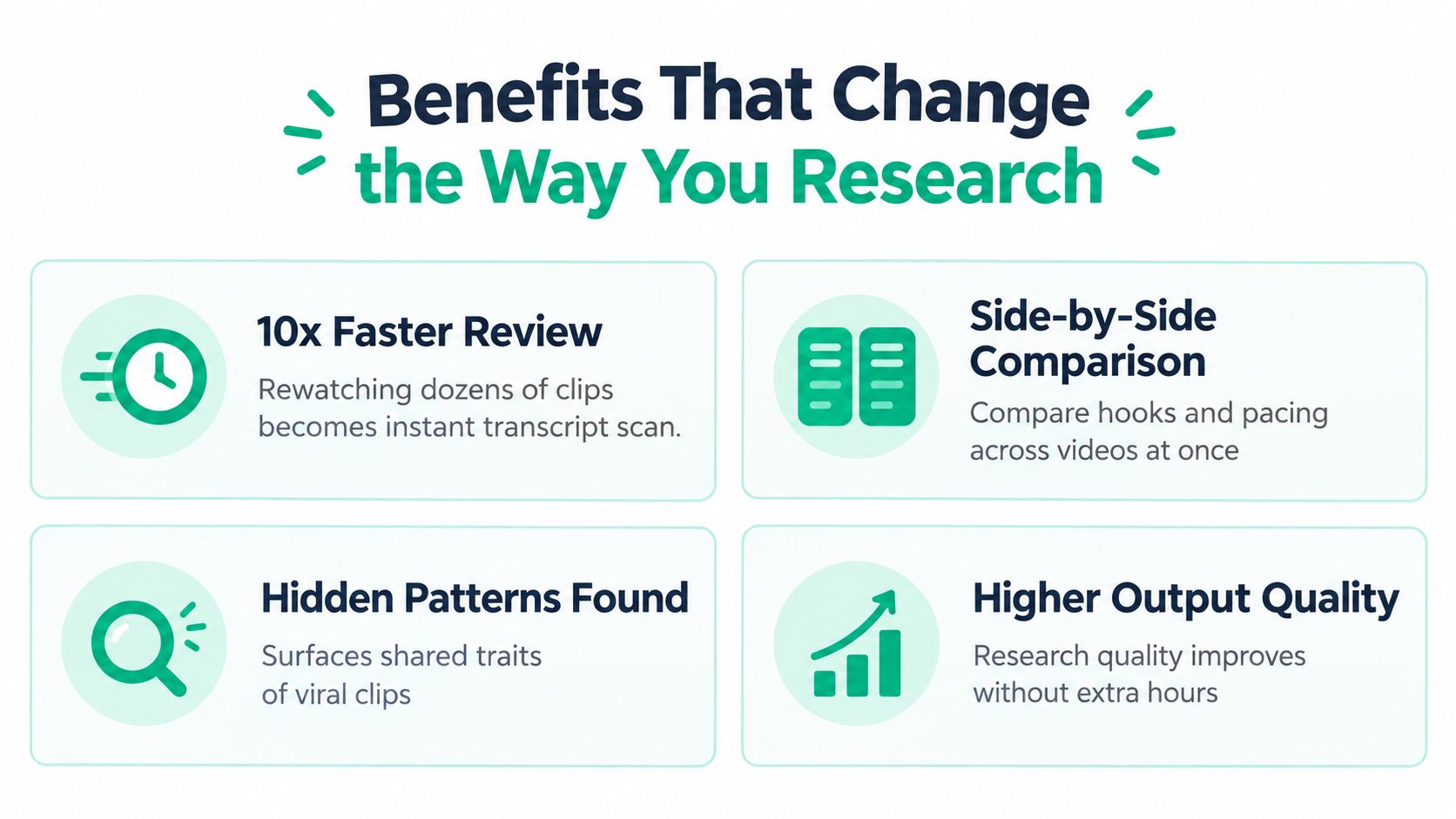
The first benefit is less mechanical review. Instead of replaying a collection of clips and writing rough notes by hand, you can scan transcripts, jump to timestamps, and compare labeled sections. That changes your role from transcription clerk to analyst.
The second benefit is consistency. Human researchers often remember the most dramatic clip and forget the ordinary ones. A structured library gives every video the same basic inspection: opening language, visual context, pacing, turning point, payoff, and CTA.
Pattern discovery needs a library
A single video can mislead you. A group of videos can reveal a recurring format:
- Opening pattern: Creators begin with a question, contradiction, result, or warning.
- Proof pattern: They demonstrate the claim, quote a user problem, or show a before-and-after sequence.
- Pacing pattern: They alternate explanation with visual resets instead of delivering one uninterrupted monologue.
- Closing pattern: They connect the CTA to the viewer's next action rather than adding a generic request.
That comparison helps you separate a creator's personal style from a format that appears repeatedly within a niche. It also supports a repeatable weekly habit. You can add new clips, search for emerging phrases, compare them with your own uploads, and update your working hypotheses before scripting the next batch.
The market context supports this shift toward structured video understanding. One market estimate values AI video analytics at USD 5.04 billion in 2025, USD 6.19 billion in 2026, and projects USD 17.23 billion by 2031, with a 22.72% CAGR from 2026 to 2031. A broader estimate places video analytics at USD 12.71 billion in 2024 and projects USD 37.84 billion by 2030, according to Mordor Intelligence's market report. For creators, the practical meaning is simple: automated video understanding is becoming an established software category, not just an experimental feature.
Where Video Content Analysis AI Still Falls Short
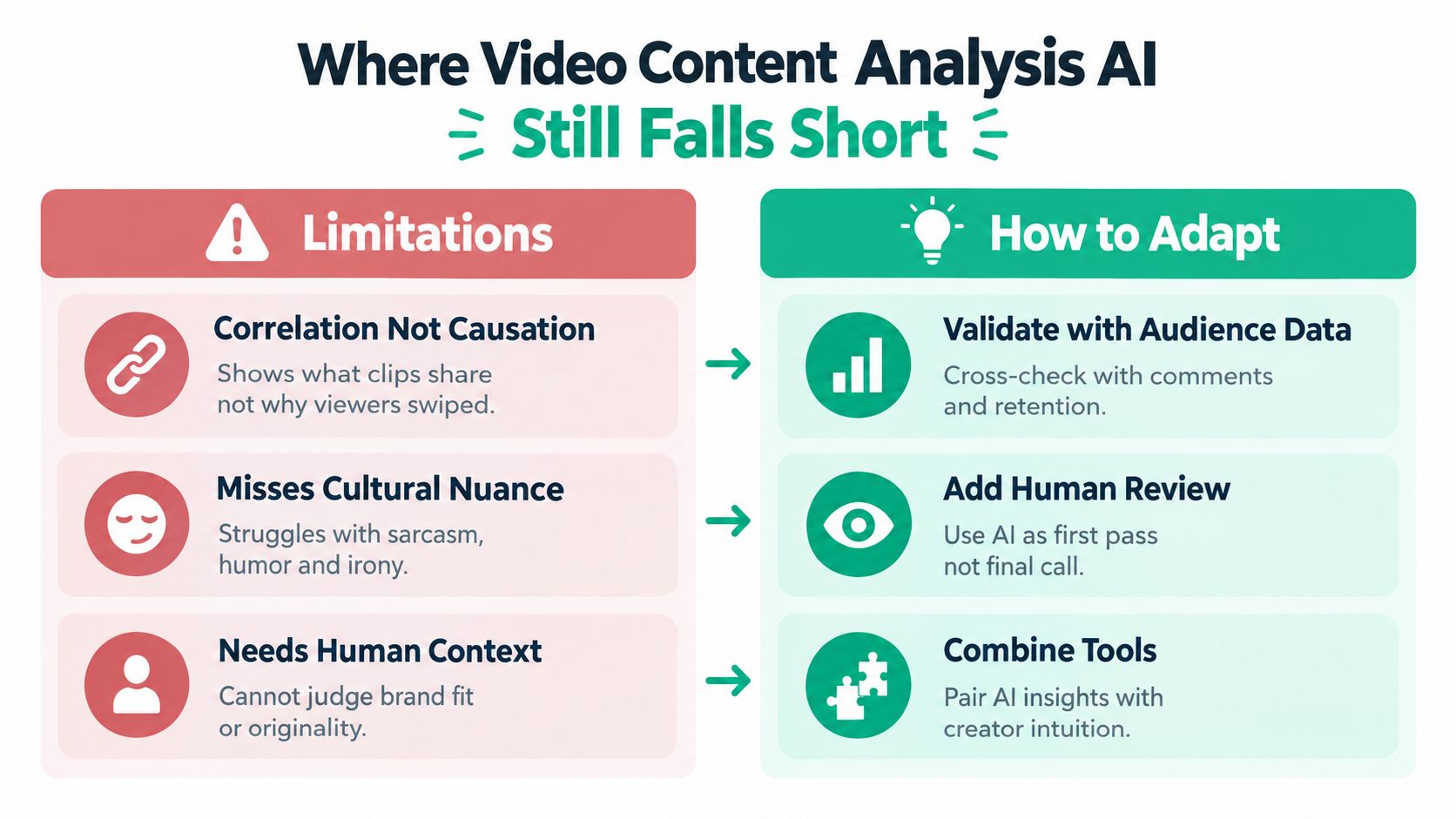
AI can show that successful clips share a structure. It can't prove that the structure caused a viewer to stay. A direct warning may work because of the creator's credibility, the timing of a conversation, a platform trend, or an audience need that the model can't observe in the file.
Short-form formats also change quickly. A hook that feels fresh can become familiar after repeated use, while a model trained on earlier examples may continue recommending the old pattern. That's why a generated “viral score” should be treated as an organizing signal, not a prediction of audience behavior.
The difficult cases
Models can struggle when meaning depends on context rather than obvious labels:
- Stylized text: Decorative fonts, low contrast, or fast overlays can reduce text recognition quality.
- Accented speech: Automatic speech recognition may mishear names, technical terms, or compressed dialogue.
- Non-verbal storytelling: A facial reaction or physical demonstration may carry the point without a transcript.
- Irony and humor: The literal words may conflict with the creator's intended meaning.
- Music-led edits: Rhythm, tension, and emotional release can depend on sound patterns that a structural report describes only partially.
Temporal reasoning remains a major boundary. The TimeLoc research focuses on locating when actions begin and end, reporting gains such as +1.3% and +1.9% mAP on THUMOS14 and EPIC-Kitchens-100, +1.1% on Kinetics-GEBD, and +2.94% mAP on QVHighlights, with an average mAP of 31.2%. Those benchmark results show why precise boundaries matter, but they don't turn a model into an authority on creative causality.
Practical rule: Use AI to generate hypotheses, then validate them against your own retention, comments, and outlier videos.
The strongest workflow combines automated review with deliberate human inspection. Watch clips that break the apparent pattern, read repeated viewer questions, check whether the recommendation fits your audience, and test one structural change at a time.
A Practical Rollout Plan for Creators and Teams
Start with a focused pilot rather than processing every video you can find. Choose one niche and gather 30 to 50 reference clips from TikTok, Reels, and Shorts. Run them through transcript-backed analysis, then map the openings, pacing choices, narrative turns, and CTAs.
The point of the pilot isn't to find a universal formula. It's to create a local vocabulary for your niche. You might discover that creators lead with objections, teach through demonstrations, or delay the main explanation until after a visible result. Record those observations as hypotheses your own content can test.
Turn observations into templates
Build reusable briefs from structures that appear repeatedly:
- Define the promise: What will the viewer understand, solve, or see by the end?
- Write several openings: Keep the idea original while borrowing the structural role of a proven hook.
- Plan the turn: Decide where the problem becomes more specific, surprising, or urgent.
- Place the proof: Match the spoken claim with a demonstration, screenshot, example, or visual change.
- Finish with a relevant CTA: Ask for the next action that naturally follows the payoff.
A small team can divide the workflow cleanly. One person collects and tags clips, another turns patterns into scripts, and an editor checks whether the planned visual moments support the spoken structure. A short review meeting can focus on where the model's labels were useful, where they were wrong, and which experiments deserve another test.
Create a weekly learning loop
Review new top-performing examples in your niche, compare them with your own library, and note where familiar patterns fail. Tag clips by topic, hook type, audience objection, visual device, and CTA so future searches answer specific questions.
Keep a private swipe file, but store the reason each clip matters. “Strong opening” is too vague. “Opens with a specific objection, shows the consequence immediately, then explains the fix” gives your next script a usable design constraint.
Before investing more, define the audience outcomes you'll monitor, such as hook response and completion behavior, and compare your tests over a consistent review window. The AI report can organize the evidence. Your publishing data decides whether the pattern deserves to survive.
TransClipper helps creators and teams turn TikTok, Instagram Reel, and YouTube Short links into searchable transcripts with structured analysis of hooks, narrative beats, and CTAs. Visit TransClipper to build a repeatable research library, compare short-form patterns, and start testing what keeps your audience watching.


